A Publication of Guide Dog Users, Inc.
Audio Content:
President: Sarah Calhoun
Editor: Andrea Giudice
Co-editor and GDUI Immediate Past President: Penny Reeder
Guide Dog Users, Inc. (GDUI) A special interest affiliate of the American Council of the Blind (ACB) since 1972
Toll-Free: 866.799.8436
***
From the editor- Hello fellow GDUISters
Here it is, hot off the press, well from my computer, the June 2026 Paws for GDUI News You Can Use! Speaking of hot… lots of this issue is dedicated to dealing with the hot weather and our guides. Of course, there are lots more. Book and film recommendations; technology updates; news from NLS; shopping ideas; yummy recipes; cool Apps; helpful blogs and webinar; informative announcements; member submissions; tributes; and so much more! I really had fun compiling this issue, and I learned a lot too! *smile*
I encourage everyone to remember how easy it is to get involved- share a favorite podcast; blog; webinar; an interesting, silly, absurd, or touching tidbit from your local paper; something you wrote yourself or written by someone else; a helpful app or other resource; even a yummy recipe. Remember, submissions about guide dogs, or blindness/visual impairment are not the only topics of interest to us GDUISters!
Sending cyber hugs and wags,
Andrea and Super T
*****
Canine Contemplations
Toto’s Topics-I want to tell you about something my Mom does to help her keep her t-shirts, and so many other things sorted. I can’t tell you how many times I have heard Mom express her frustration at how difficult it is to know which t-shirt is which. She says that of all her clothes they are the most similar feeling and the hardest to label because they have sayings and funny pictures that the pre-made clothing labels simply can’t handle. So, she uses packing cubes. I know, these sound like rigid, space inefficient devices, however, quite to the contrary, they are wonderfully flexible! Mom learned about them from my uncle Nicholas who travels lots for work, and fun! They are actually pouches, of varying sizes, that close with zippers. They are made to keep clothes in a suitcase organized. Mom puts t-shirts by category in each packing cube and then labels it in braille. She also uses the same system for gift bags, and all her holiday specific clothing, accessories, dish towels, and my collars. So, all the fourth of July stuff is in one packing cube, all together, and neatly labeled. Same goes for all the guide dog themed t-shirts, happy birthday gift bags Etc. Mom says she was so happy the day she discovered packing cubes! She uses them for pretty much everything… except packing her suitcase! *Big doggie smile*
Winnie’s Wisdom- Well, as storage seems to be the topic dejour- here is a trick, and I truly mean trick, my Mom uses. She is in the habit of using zip top bags to organize, and I mean organize everything! She puts cords; chargers; the print manuals that some times still come with appliances and electronics; greeting cards she wants to keep distinguished from one another; and anything that needs to stay together. She “labels” the bag by brailling the contents on an index card and placing that in the bag so she can read it through the plastic, or open the bag if she has difficulty reading it from the outside. Sometimes she tapes it to the front of the bag so she doesn’t have to take time to open or reach inside. She also *always* puts liquids in zip top bags before putting them in her backpack! I mentioned earlier that this is a trick, that is because she also packs my food and treats in the same type of bag whenever she is packing meals for me and so each time, I hear a zip top bag being opened I believe it is time for a treat or meal- alas, more often than not, it is not! *Sad doggie face*
*****
For Your Calendar-
(Some of the items listed here are expanded upon later in this issue, a few may be quite truly nipping at your heels, and others may not be happening for a month of Sundays!)
6/1-30/26- Dog Licensing month
6/4/26- Non-member registration opened for 2026 ACB Conference and Convention
6/21-27/2026- Deaf/Blind Awareness Week
6/25/2026, 6:00PM (Eastern)- Webinar on Recognizing Neurological Emergencies in Pets
6/27/2026- Helen Keller’s birthday!
6/27/2026, 7:00 PM, ET – New York premiere of documentary “Possibilities”, at Carnegie Hall and streaming nationally
7/6/26, 11:59 PM, CT Pre – registration closes for 2026 ACB Conference and Convention
7/24-31/26 – 65th annual ACB Conference and Convention
7/26/2026, 5:00- 6:15 PM, CT – GDB reception at ACB Convention (In-person only)
7/29/2026, 5:00 – 7:00 PM, CT – The Seeing Eye: Guiding the Way Forward
8/8/2026 1:00 PM,ET – GDUI Board meeting
9/26/2026, 1:00 PM, ET – GDUI Board meeting
10/5-7/2026 – M-Enabling Summit
10/18/2026, 5:00 PM,ET – GDUI Annual Membership meeting
11/21/2026, 1:00PM, ET – GDUI Board meeting
1/17-24/2027 – 52nd international Ski for Light
Recurring events-
Every second Thursday (monthly), 7:00 PM, ET — Get to Know the Many Faces of BARD (virtual)
Every Third Thursday (monthly) — NLS- Smart Speaking to the Smart Speaker (virtual)
Every Last Tuesday (monthly)– NLS- That All May eRead Program (virtual)
*****
Calendar Event- Get your Guide, and any other dogs, licensed!
Keep your Pup out of the paws of the Popo!
By the book. Did you know that guide dogs are not exempt from local animal control or public health requirements? They’re also subject to the same licensing rules that are applied to all other dogs. However, in many states the licensing fee is waived for service animals. Check to see if your state provides an exemption.
https://www.animallaw.info/topic/table-state-assistance-animal-laws
******
Calendar Event- You’re Invited! Webinar on Recognizing Neurological Emergencies in Pets
[Schwarzman Animal Medical Center- https://www.amcny.org/usdan-institute-for-animal-health-education/]
Neurologic signs in dogs and cats can be concerning for pet owners to witness. Seizures, weakness, loss of balance, collapse, or unusual behavior may occur suddenly and can be difficult for owners to interpret.
Join us on Thursday, June 25 at 6PM ET on Zoom as Dr. Zoe Daniels, a board-certified veterinary neurologist at AMC, discusses common neurologic warning signs in dogs and cats, when veterinary evaluation may be recommended, and what pet owners should know if these signs occur.
This webinar will help pet owners better understand neurologic signs and feel more prepared should an emergency arise.
Please email UsdanInstitute@amcny.org with any questions
Register for the “Recognizing Neurological Emergencies” Webinar- https://app.glueup.com/event/recognizing-neurological-emergencies-in-dogs-and-cats-182087/
*****
Calendar Event- Join us, on June 27, at Carnegie Hall for the documentary film, “Possibilities,”
Presented by the American Foundation for the Blind
Join the American Foundation for the Blind (AFB) as we celebrate the 146th birthday of Helen Keller with the New York premiere of its award-winning documentary film “Possibilities.” Taking place on the evening of Saturday, June 27th, this event is one you don’t want to miss.
“Possibilities” is a documentary film celebrating the legacy of Helen Keller as told through the shared stories of 21st-century voices. Held at the world-renowned Carnegie Hall in the intimate setting of Zankel Hall, this special evening will celebrate the power of storytelling, accessibility, and human potential through the first full-length documentary film produced with open audio description for all audiences.
- When: Saturday, June 27, 2026, 7:00 PM to 9:00 PM
- Where: Zankel Hall at Carnegie Hall, New York City
Following the screening, guests are invited to stay for a live panel discussion featuring director Bill Sarine and voices from the documentary, who will share insights into the making of the film and the stories that inspired it.
Tickets are on sale now and can be purchased online, in person at the Carnegie Hall box office at 57th Street and Seventh Ave, or by phone at 212.247.7800.
Click here.
Join us for an unforgettable evening honoring vision, resilience, and possibility in one of the world’s most iconic cultural venues.
Access the trailer and learn more about the film here
We look forward to welcoming you!
Additionally- (for those of us, like this editor, who can’t be there live, Possibilities Streams Nationwide Beginning June 27!
Available on the following-
Additional streaming platforms may be announced as they become available.
Apple TV users can pre-order Possibilities now!
https://tv.apple.com/us/movie/possibilities/umc.cmc.3jqjqrjvgobfhmltxvw9nkpfs
***
The 2026 GDUI Drawing for Plush Guide Dogs in Harness!
Greetings to all GDUI Members and Friends,
It’s that exciting time of year again! Hava has once again blessed us with five very special four-footed friends Ruffles, Snickers, Valor, Lewis, and Kelly. Each sporting a beautiful tan 100% leather harness and ready to become a cherished part of your family.
We invite you to take this opportunity to enter the drawing for your favorite faithful companion.
Entries are 3 for $5 or 7 for $10.
You can enter in any of the following ways:
Purchasing tickets online at 2026 Plush Pups Drawing – Guide Dog Users, Inc. (GDUI) (various payment methods available; does not require a PayPal account)
Purchasing tickets over the phone by calling Office Manager Lynn at 866-799-8436
Or by purchasing tickets in the Bark-A-Lounge (sponsored by Nestlé Purina)
Entry sales will close on July 28th at 10:00 PM Central Time, and the drawing will be held July 29th, during the final session that begins at 1pm Central Time.
Read on to meet these five wonderful pups who could soon become part of your family!
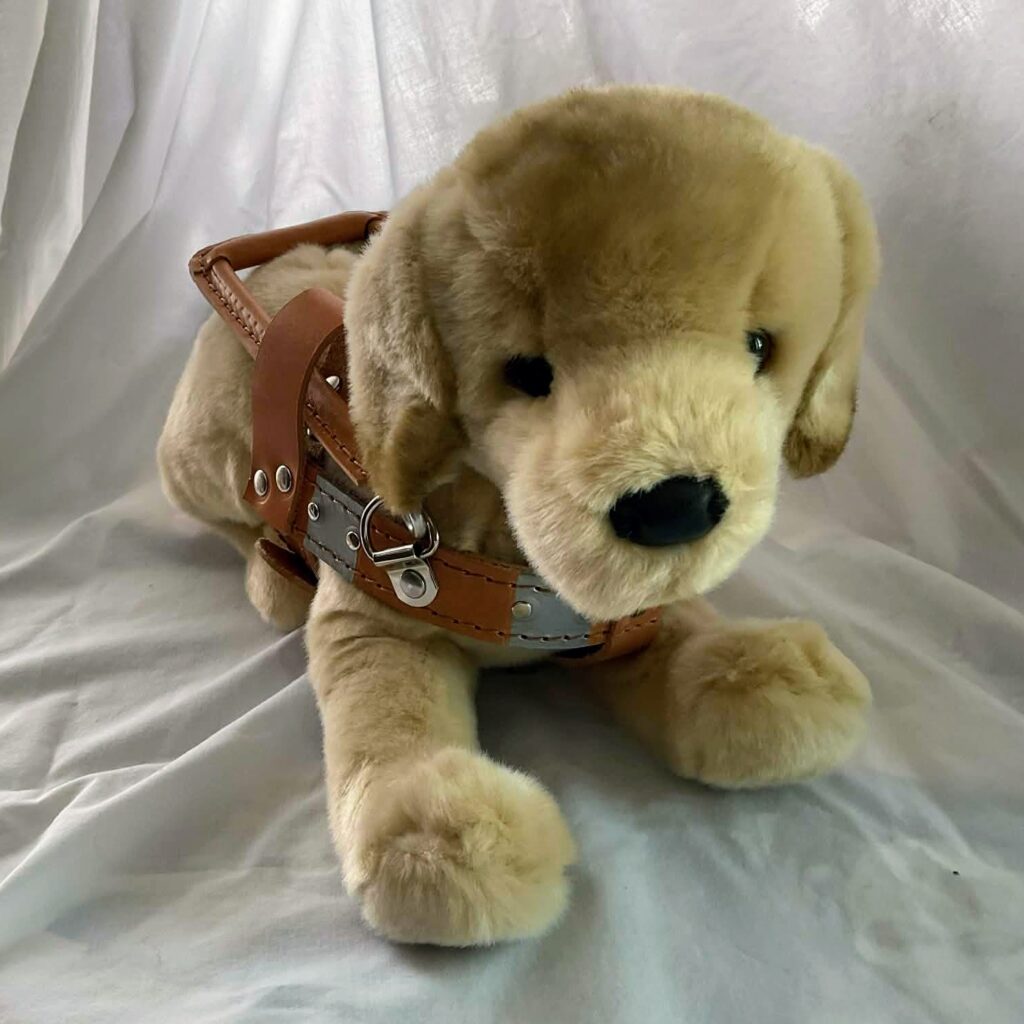
Ruffles is a very stylish yellow Labrador lady who stands 9 inches tall and 15 inches long. She’s posed in a cheerful play-bow position, front paws down and tail high, as if ready to dash into action. Ruffles is a girl completely devoted to duty. She loves being right by your side, always alert and eager to help. When it’s time to rest, she curls up happily in her kennel for a peaceful snooze. But the moment she hears the words “Let’s go to work!” she’s up in an instant, wide awake and ready to slip into her harness.
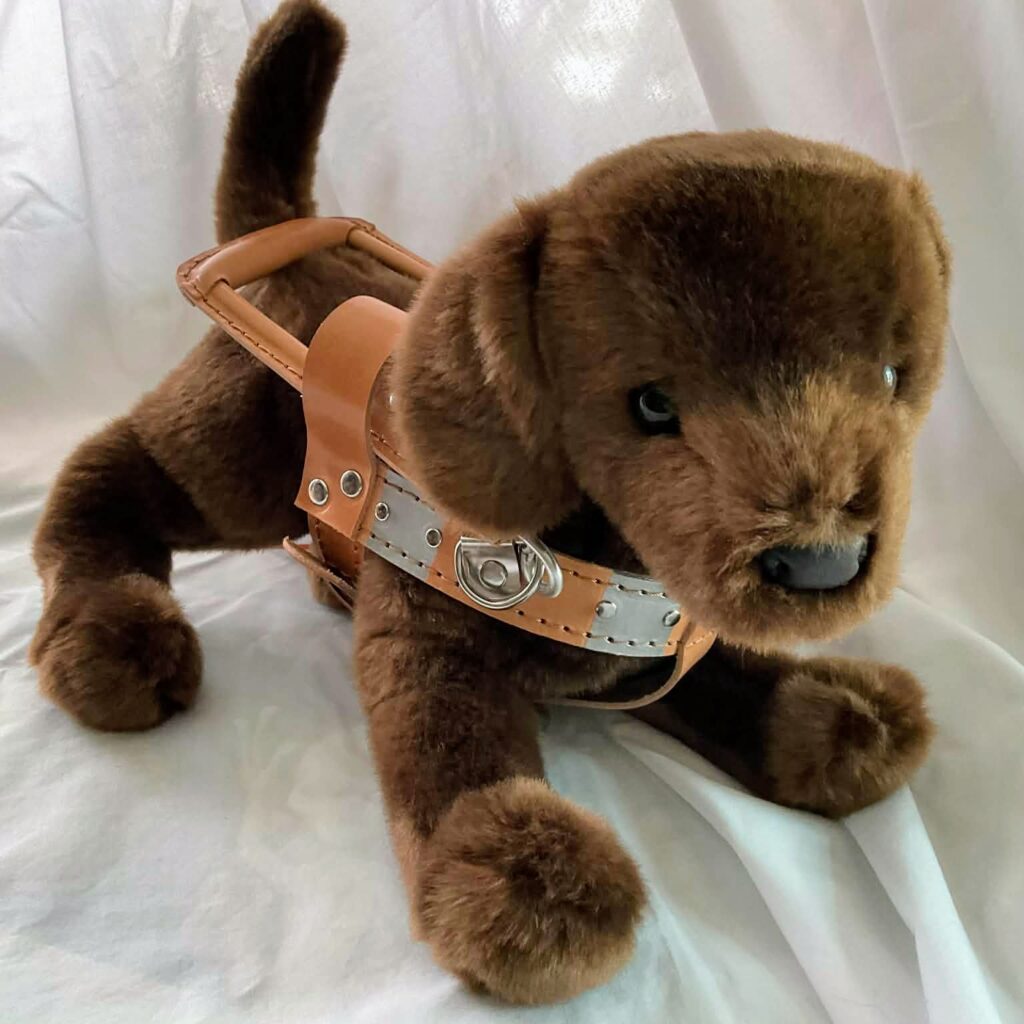
Snickers is an incredibly sweet female chocolate Labrador who stands 9 inches tall and measures 15 inches from the tip of her nose to the tip of her tail. She’s posed in a playful bow, her front paws stretched forward and her tail raised high, as if inviting you to join in a game. Snickers takes her job as a guide very seriously—her ears perk at every sound, always alert and ready to help. But once the harness comes off, her serious side melts away. There’s nothing she loves more than curling up close for some warm, cozy cuddle time with her favorite person.
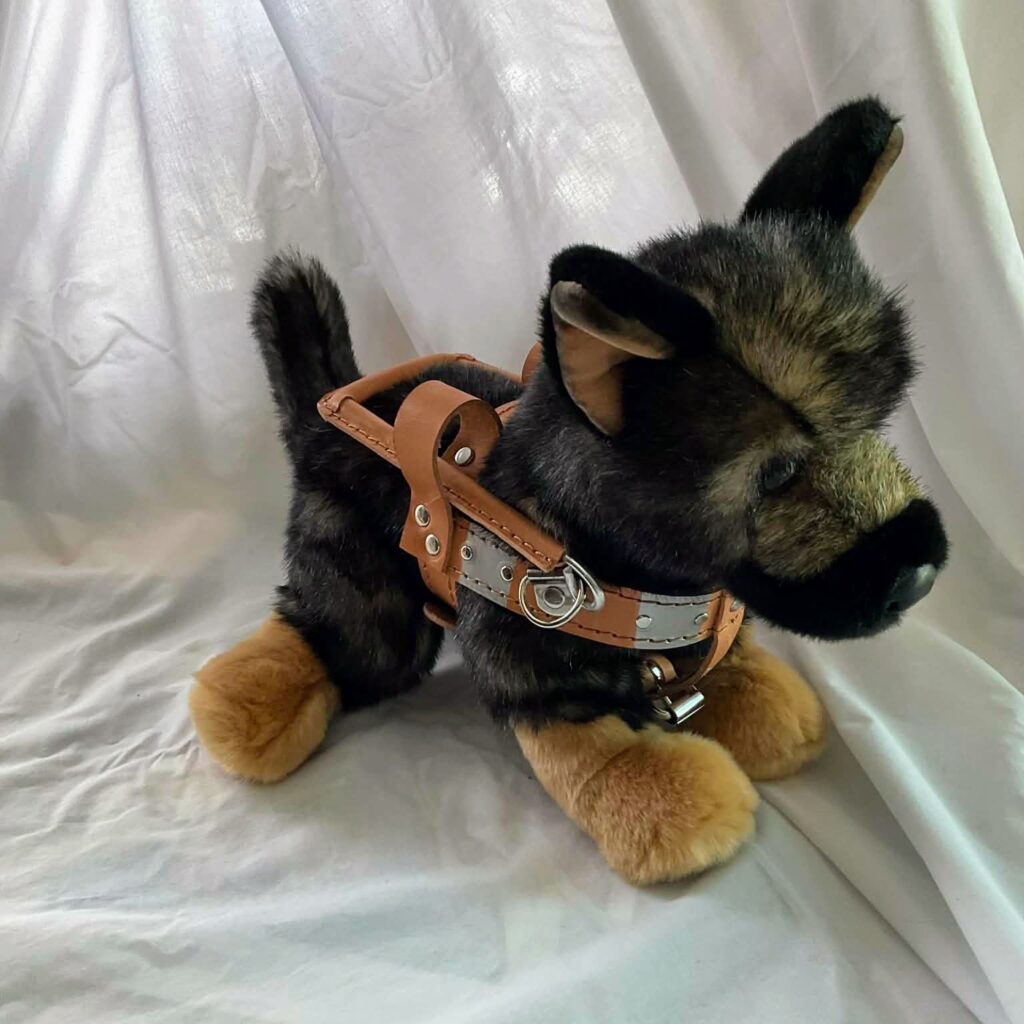
Valor is a very handsome male German Shepherd with a sleek black coat interlaced with warm tan markings. He stands 11 inches tall and 17 inches long, poised in a relaxed standing position with his head held proudly high. Valor has a bit of a playful side; his strong prey drive makes those darting squirrels quite the distraction but with a gentle word, he quickly refocuses on his guide work. Once he’s in the zone, Valor shows just what a steady, confident, and devoted worker he is.
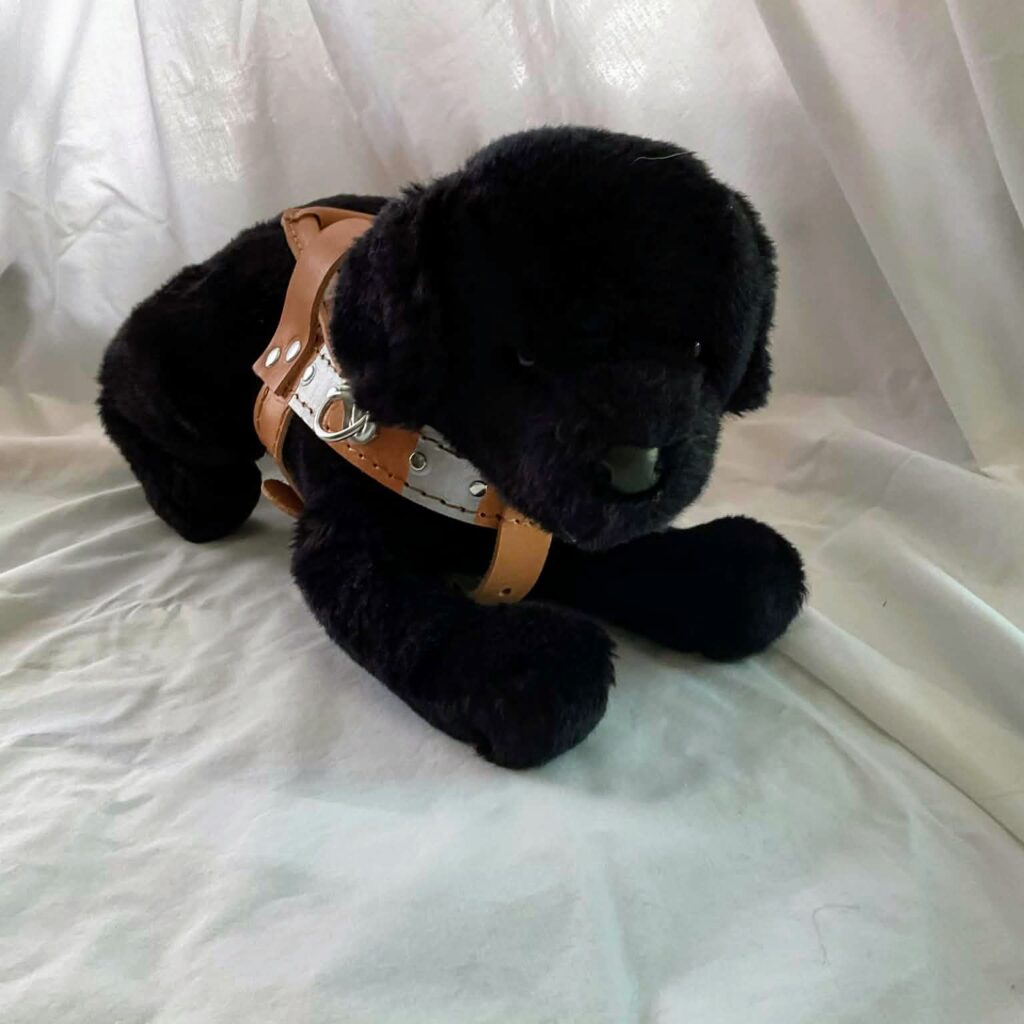
Lewis is a debonair male black Labrador Retriever who stands 9 inches tall and 15 inches long. He’s posed in a cheerful play-bow, front paws stretched forward and tail lifted high, full of energy and enthusiasm. Lewis likes to think of guiding as his very own superpower—and what a saint of a Labrador he is! He loves to chase and play with his favorite ball, but the moment he sees his harness come out, he springs to his feet, tail wagging, and leaps right into it, eager and proud to get to work.
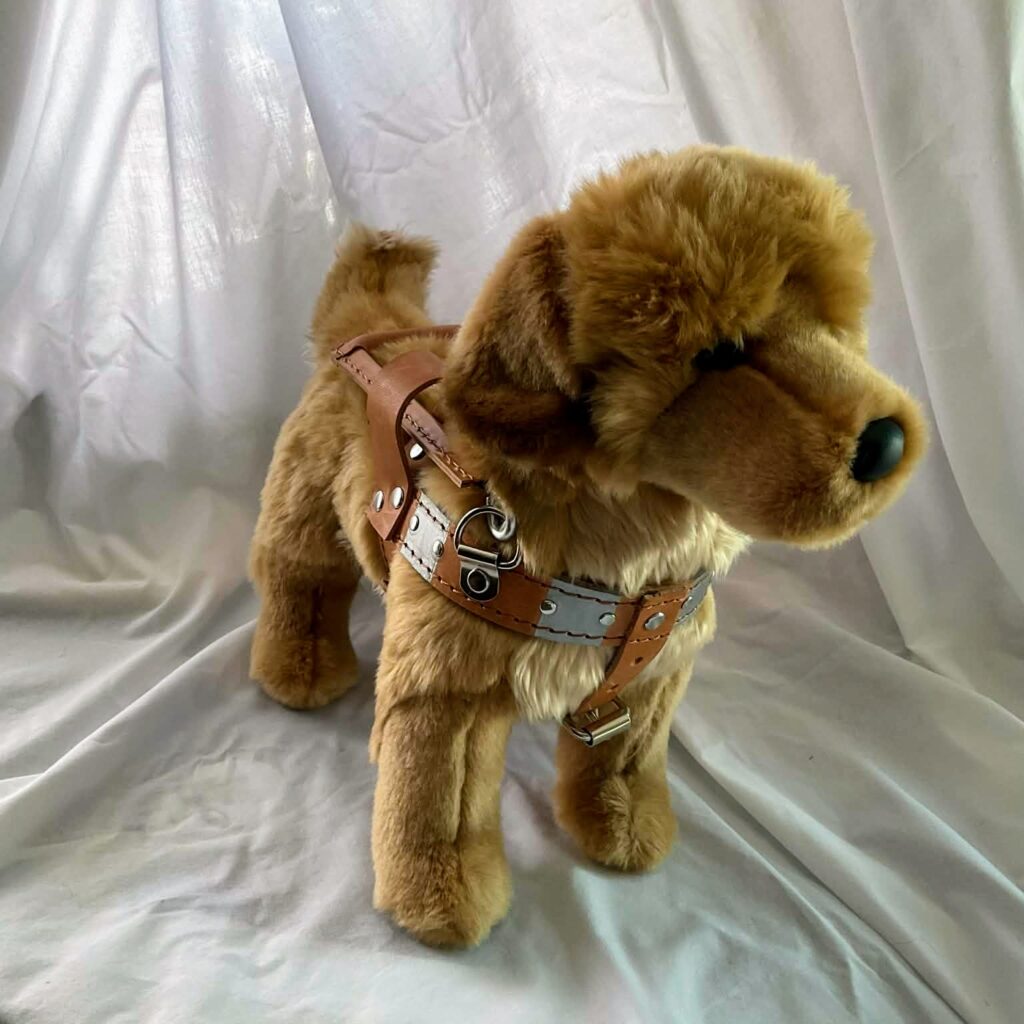
Kelly is a beautiful female Golden Retriever who stands 12 inches tall and measures 17 inches from the tip of her nose to the tip of her tail. Her silky golden coat shines as she stands ready, tail gently wagging. Kelly is a happy go lucky girl who radiates cheer wherever she goes, but when it’s time to work, her focus sharpens. Ears forward and head high, she becomes all business calm, confident, and completely devoted to the job at hand.
Each of these five amazing pups comes with their very own working harness, crafted from 100% leather with real metal fittings—just like those used by real guide dogs. They’re ready to bring joy, companionship, and plenty of smiles to their new homes!
When you enter the drawing, you’re not just taking a chance on bringing one of these lovable pups home you’re also supporting the important work of Guide Dog Users, Inc. and helping guide dog teams across the country.
So don’t miss out, enter today, make a difference, and you just might take home your new best friend!
*****
The passing of eric Loori Founder of Freedom Guide Dogs for the Blind
May 28, 2026
It is with profound sadness and heartbreak that we share the passing of our founder, Eric Loori, early this morning.
This sudden and tragic loss is deeply felt throughout our entire Freedom family and beyond. Eric was more than the founder of Freedom Guide Dogs. He was the heart behind the mission, a visionary leader, a mentor, a friend, and an inspiration to so many whose lives he touched.
Our hearts, prayers, and thoughts are with Sharon, his beloved wife; their daughters, Holly and Anna; their son, Emmett, and Emmett’s wife, Sammie; along with the rest of their family and everyone who knew and loved Eric.
Eric dedicated his life to changing the lives of others with compassion, kindness, and unwavering purpose. His impact on the blind and visually impaired community, on our organization, and on each of us personally cannot be measured. He truly was the best.
As we grieve together, we also honor the incredible legacy he leaves behind, one that will continue through every life changed by Freedom Guide Dogs.
We ask that you keep the Loori family in your prayers during this unimaginably difficult time.
With love and sorrow,
All of us at Freedom Guide Dogs
Ashleigh Pace
Breeding and Puppy Program Manager
From GDUI
GDUI mourns the sudden passing of Eric Loori, co-founder of Freedom Guide Dogs for the Blind and its Executive Director for an amazing 34 years. The school was started by Eric and his wife Sharon. It was only the second school to train exclusively at home.
Eric impacted the lives of many guide dog users including members of GDUI. He helped innumerable blind and visually impaired people gain confidence and independence. He was a kind and compassionate man who loved his work and personally trained many guide dog teams.
GDUI sends heartfelt condolences to Eric’s family, Freedom Guide Dogs’ staff, and all those who worked and trained with him. He will be missed.
*****
The Day I Taught a Human Pup
by: Boaty Skilled Professional Guide Dog Extraordinaire
From: https://theanthonycorona.substack.com/p/the-day-i-taught-a-human-pup
I will tell you a story my pack loves to hear, even though I tell it with extra tail wags every single time.
It was a long platform kind of day. The kind where the wind smells like faraway places and the ground hums before the train even arrives. Dad, also known as Anthony, and I were sitting on a bench. I was in harness, focused, ears tuned like tiny satellites.
Dad was on his phone.
Now listen. I love my dad. But that phone talks more than a parrot who drank coffee. Jabber jabber jabber. Voiceover, he calls it. I call it The Endless Talking Rectangle. I sometimes wonder if it needs a nap.
Anyway, I was working. Even when we sit, we work. That is part of being a guide dog. You stay ready. You stay steady. You stay the goodest of good boys.
Then came a mom with two small humans. One was about seven, full of school knowledge and brave eyes. The other was a tiny baby strapped to the mom’s chest. I tilted my head.
That looks uncomfortable, I thought. For the mom. For the baby. For everyone involved. But I am a professional, so I returned to my post.
The mom pointed at me. She said to the girl, Go say hi to the doggie.
My ears flicked. Dad’s head tilted just a little. He was listening now.
The girl did not move. She said, Mommy, we learned in school that you are not supposed to talk to them or pet them when they are working. They have a harness. That means they are doing a job.
I liked this human pup immediately.
The mom said, It is okay honey, they are just sitting there.
I could feel Dad straighten a little beside me.
The girl said, No mommy, that is not okay. The dog is helping him. We should not distract him.
Back at home, when I told this part, Puppy Gabe rolled onto his back and said, Wait, the small human trained the big human!
Posh gave a soft huff and said, Finally, someone with sense.
Parker wagged so hard he bumped the water bowl and said, Did you get snacks though! This is important.
Yes, Parker, patience. There are always snacks if you play your paws right.
Back on the platform, Dad spoke. His voice was warm, like sunshine on a nap spot.
He said, Your little girl is right.
The mom blinked. The girl stood taller.
Dad asked, What is your name!
The girl said, I am Ali.
Dad smiled. I could hear it in his voice. He said, Ali, do you want to play a little game with me and my guide dog!
Now listen closely. This is where I become not just a professional, but an artist.
Ali said, Yes! like a firecracker.
Dad reached into his bag and took out Charlie Bear treats. Ah yes. The golden coins of my kingdom.
He told Ali, Watch this. Boaty, sit.
I sat like a statue carved from very handsome marble.
Ali giggled.
Dad said, Down.
I melted into a perfect down, chin proud, tail still.
Ali held a treat in her small hand. I could smell it. I could taste the future.
Dad said, Up.
I rose smoothly, eyes forward, waiting.
Dad said, Heel.
I stepped into position beside him, shoulder aligned, the way we practiced at Guide Dog school and every day since.
Then Dad said, Visit.
Now this is special. When I first came home, Dad taught me this command. It means I can politely leave my working position for a moment to say hello, to share a little love, and then return to duty.
I stepped toward Ali. Gently. Carefully. She placed her hand on my head.
Good boy, she whispered.
She gave me the treat.
Victory.
Puppy Gabe interrupted me at this point in the retelling and said, Did you get more than one treat!
I lifted my nose and said, Of course I did. I am a professional.
Posh said, And did you return to heel without being told twice!
I said, Naturally.
Parker said, I would have eaten all the treats and then the bag.
Yes, Parker. That is why you are not in charge.
Back on the platform, Dad showed Ali a few more commands. Sit, down, up, heel, visit. Each time, I followed perfectly. Each time, Ali gave me a treat and a giggle.
The mom watched quietly now. Learning.
Dad said, You see, Ali knows something very important. When I am working, Boaty is helping me stay safe. But with permission and the right moment, we can share a little kindness too.
Ali nodded like a tiny professor.
Then the train came. The ground hummed. The air shifted.
I returned to heel. Focused. Ready.
As we boarded, Ali waved and said, Bye Boaty!
I wagged once. Professional, but friendly.
And that, my dear pack, is how I taught a human pup and her mom that respect and kindness can walk together, just like a guide dog and his dad.
Puppy Gabe sighed and said, I want to go on a train.
Posh said, I want more stories.
Parker said, I still want the treats.
I curled up, proud and sleepy, and said, Tomorrow, I will tell you about the time Dad dropped a whole sandwich.
Now that is a legend.
******
Are there any uses for dog hair?
Yes, surprisingly, dog hair can actually be useful. It’s not just waste. Here are the most practical ways people use it:
- Natural fertilizer
Dog hair breaks down slowly and adds nitrogen to soil. You can:
- Mix it into compost
- Bury small amounts in garden soil
- Use it around plants as a slow-release nutrient
Just avoid large clumps, as they can mat and block water.
- Pest deterrent
The scent of dog hair can keep certain animals away.
- Scatter it around gardens to deter deer, rabbits, and squirrels
- Works best when refreshed regularly
- Bird nesting material
Birds often collect soft fibers for nests.
- Put small amounts outside in spring
- Don’t use chemically treated or flea-medicated hair
- Oil spill absorption (less common at home)
Dog hair absorbs oil well.
- It’s been used in environmental cleanups
- At home, it can soak up greasy spills in a pinch
- Crafting and yarn (if you’re adventurous)
Dog hair can be spun into yarn, sometimes called “chiengora.”
- Can be knitted into hats, mittens, or scarves
- Works best with long-haired breeds
- Stuffing material
Cleaned dog hair can be used for:
- Pet beds
- Pillows (less common, but doable)
What I would NOT recommend:
- Don’t burn it indoors (smells strong and unpleasant)
- Don’t leave large piles in your yard (can clog drainage or attract pests)
If shedding is heavy, it may also be seasonal (spring/fall coat change), but excessive shedding can sometimes point to diet or health issues. If the amount of shedding seems unusual, a quick check with your vet is a good idea.
******
Do Dogs Like Hugs? How to Tell If Your Pup’s a Fan
Find out if they’re up for affection or prefer their personal space.
By Lindsay Boyers. Reviewed by Kelly Gold, DVM, Aug. 7, 2025
[Advice from chewy.com]
You love your dog, so it’s natural to want to wrap them up in a big, heartfelt hug. But do dogs enjoy hugs the same way humans do? While some pups may welcome a warm squeeze, others might find it confusing, uncomfortable, or even stressful.
- Dogs don’t instinctively interpret hugs as affection.
- Some dogs enjoy hugs, while others feel trapped or anxious.
- Relaxed body language signals comfort; stiffness or avoidance signals stress.
- Never force a hug—let your dog initiate closeness.
Is It OK to Hug Your Dog? It’s OK to hug your dog if they like it. Just like humans, dogs have varying levels of comfort with hugs. While you see hugging as a way to show affection, your dog might not interpret it the same way.
“Dogs do not inherently understand hugs the way humans do,” says Samuel Varon, DVM, a companion-animal veterinarian and owner of Broadway Animal Hospital
in Sacramento, California. “While some dogs may tolerate or even enjoy the physical closeness, others may feel uncomfortable or stressed.” Whether a dog enjoys hugs often depends on their personality and past experiences, including how well they’ve been socialized. Some dogs are naturally more comfortable with close contact, while others feel trapped or anxious when held too tightly, according to Bethany Hsia, DVM, co-founder of CodaPet. That’s why it’s crucial to let your dog set the pace. Hugging should be something that happens on their terms, and if your dog isn’t into it, it’s best to respect their personal space.
But how can you tell if your dog likes a good squeeze as much as you do? They’ll usually give you
signs that they feel secure and relaxed.
- Relaxed Body Language- Relaxed body language is one of the clearest ways to tell that your dog is comfortable with affection, says Dr. Varon. When a dog is at ease, their muscles
are loose, their eyes are soft, and they may wag their tail. They might also blink slowly or have an open mouth with a relaxed tongue.
- Leaning Into You- Dogs who enjoy hugs will often push into the contact rather than pull away, according to Dr. Hsia. Leaning into you can also be a dog’s way of seeking more affection, especially if paired with other relaxed body cues like soft eyes or a wagging tail.
- Gentle Licking- In dog language, licking is a social behavior that strengthens bonds and helps them express affection. So gently licking your hands or face might be your dog’s way of trying to show that they’re a big fan, according to Dr. Varon. However, dogs sometimes also lick as a sign of submission, so it could also be a polite way of saying “please stop.” Pay attention to the rest of their body language for context about what your dog’s lick means.
- Nuzzling or Resting Their Head on You- If your dog rests their head on you or nuzzles against you, it’s a subtle sign they’re enjoying the moment and trust you deeply, according to Dr. Hsia. An even stronger sign is if they seek out hugs and physical affection on their own.
How Can You Tell If Your Dog Hates Hugging? On the flip side, some dogs will show clear signs that they’re not comfortable with a snuggle, and that’s OK too. Their
body language speaks volumes, so keep an eye out for these
stress signals-
- Tense muscles or rigid posture
- Turning away
- Avoiding eye contact or showing the whites of their eyes
- Whining, whimpering, or growling
- Pinning their ears back
- Tucking their tail
- Trying to escape
If your dog is showing any of these signs, you should respect their boundaries, Dr. Hsia says.
5 Reasons Your Dog Might Not Want a Hug- If your pup pulls away or stiffens up when you go in for a squeeze, it’s not personal—there’s usually a reason behind it. Here are a few that might explain why your dog needs their space.
- Anxiety- Some dogs are naturally anxious, and being held too tightly can make them feel trapped or overwhelmed. Dr. Hsia says many dogs experience anxiety in close quarters, and a hug, which restricts their movement, can trigger that stress response. Even dogs that normally enjoy closeness might feel uneasy if the hug feels too confining. If your dog tends to shy away from other forms of restraint (like having their nails trimmed or being picked up), they may also be less comfortable with hugging.
- Confusion- Dogs don’t inherently understand what a hug means. While we see it as a gesture of love, dogs interpret body language very differently. In the wild, you never see dogs hugging, so when we wrap our arms around them, it can feel foreign or uncertain, according to Dr. Varon.
- Bad Associations- If your dog has had negative experiences with being held or restrained (like at the vet or during grooming), they may associate hugs with fear or discomfort. Dogs learn from past experiences, so even if your hug is gentle, it might remind them of a time when they felt scared or helpless. Dr. Varon points out that dogs who haven’t been gently exposed to close physical contact at an early age are more likely to react negatively to hugs.
- Physical Pain- If your dog is injured or has joint pain, hugging could add to their discomfort. This is especially common in senior dogs or breeds prone to orthopedic issues, like German Shepherds and Labrador Retrievers. Hugging can also exacerbate pain in dogs with physical ailments, such as arthritis or injuries, according to Dr. Hsia. If your dog flinches, yelps, or pulls away during a hug, check with your vet to rule out pain as a possible cause.
- Personal Preferences- Just like people, dogs have their own personalities, likes, and dislikes. Some dogs simply don’t enjoy being hugged, and that’s OK. It doesn’t mean they don’t love you; they just prefer other forms of affection, like a belly rub. Every pup is different, and honoring their boundaries shows true love and respect.
Other Ways to Show Your Dog You Love Them- Dogs and hugs don’t always go hand-in-paw, but that doesn’t mean you can’t build a strong, affectionate bond in other ways. Here are some things you can do to show affection-
- Pet them gently- Dogs often enjoy calm, soothing pets, especially on their belly or behind the ears.
- Spend time together- Quality time can be just as meaningful as a hug and builds trust with your dog, says Dr. Varon. Playtime, walks, and training sessions all strengthen your bond.
- Give them positive reinforcement- Dog treats or dog toys during training sessions are great rewards for good behavior.
- Respect their space- Allowing your dog to seek affection on their own terms helps them feel safe and loved. You can also give them a comfortable space to retreat to, like a cozy dog bed or hideaway tent.
FAQs About Dogs and Hugs-
Q- Do dogs feel affection when you hug them?
A- When you hug a dog, they may not understand its meaning the way you do. But if they’re comfortable, they may feel affection through the physical touch. It all depends on the individual dog.
Q: Do dogs like to cuddle?
A- It’s OK to cuddle your dog if they enjoy it. If your pup thrives on closeness, they may even initiate snuggle time with you on the couch. Always be mindful of their body language to make sure they’re comfortable.
Q- Do dogs like to be kissed?
A- Dogs don’t understand kisses the way humans do, so it depends on the dog. Some pups may tolerate or even enjoy kisses if they’ve learned to associate them with positive attention. Others might find a kiss confusing or intrusive.
Q- Do dogs understand what a hug means?
A- Dogs can associate hugs with positive experiences, but they don’t inherently understand the emotional significance behind them. Instead of seeing hugs as a gesture of love, they’re more likely to interpret them based on how the hug feels to them—either safe and pleasant or confusing and restrictive.
Q- Do dogs hug each other?
A- Dogs don’t hug in the same way humans do, but they do show affection in other ways, such as leaning against each other, nuzzling, or licking.
*****
A June Reminder: Be Kind! Be Brave! Be a Good Human!
As the sun shines brighter and June rolls in, it’s a perfect time to reflect on the kind of energy we’re putting into the world. This month, let’s remind ourselves of some simple but powerful words that carry deep meaning: kindness, bravery, honesty, respect, and decorum. These aren’t just words—they’re ways of being that shape our communities, our relationships, and our own sense of self.
Be Kind.
Kindness costs nothing but means everything. A kind gesture, a gentle word, a smile—they can all ripple outward more than we realize. Hold the door. Say thank you. Compliment someone. Be the person who chooses compassion even when it’s not convenient.
Be Brave.
Dare to wave at someone. Dare to speak up. Dare to be different. In a world that can often feel harsh or judgmental, being brave enough to be yourself—and letting others do the same—is a quiet act of revolution.
Be Honest.
Speak your truth with grace. Own your mistakes. Honesty builds trust, and trust builds strong families, friendships, and communities.
Hold Yourself with Decorum.
Let’s bring back that word—decorum. It means showing up with dignity, grace, and self-respect. How you carry yourself matters. Walk tall. Speak with intention. Act with purpose.
Be Respectful.
Twice over, respect is essential. Respect others, even when you disagree. Respect yourself enough to set boundaries and to keep learning and growing. A respectful community is a strong one.
Smile. Acknowledge Others.
It’s easy to look down or away. But what if this month, we choose eye contact and smiles? What if we start by simply acknowledging each other as fellow human beings? We are all equal. We all belong here.
Be a Pillar in Your Community.
You don’t have to be loud to be a leader. Show up. Help out. Listen. Encourage. Support. Being a good human being means being present—not perfect, but present.
This June, let’s live out these words, not just speak them. Kindness. Bravery. Honesty. Respect. Let them guide us. Let them ground us. Let them remind us that we’re better together.
Dare to be a light. Dare to advocate for others. Dare to care.
Michelle Puzzo, Executive Director, UR Community Cares
860-430-4557
©2025 UR Community Cares, Inc. | 153 Spruce Street, Manchester, CT
******
CT LAB Book List
Connecticut Library for Accessible Books (CT LAB), June 2026
This year, the United States marks the 250th anniversary of the signing of the Declaration of Independence and the founding of the country. As we reflect on the founding ideals, and consider how they show up today, we offer two handfuls of books, mostly of the period and on the period, for your reading lists. For the books about the Revolutionary period, we are highlighting books published within the last ten years. Contact your Reader Advisor if you would like more books about this topic or to request an old favorite.
*The British Are Coming: The War for America, Lexington to Princeton, 1775-1777
Written by Rick Atkinson. DB 95379
The Pulitzer Prize-winning author of An Army at Dawn: The War in North Africa (DB 54939) recounts the first twenty-one months of the American Revolution in this first volume of three. Describes principal battles, key figures, British perspective, and historical context for the conflict.
Download The British Are Coming from BARD.
*Rebels at Sea: Privateering in the American Revolution.
Written by Eric Jay Dolin. DB 110882
Largely missing from maritime histories of America’s first war is the ragtag fleet of private vessels that truly revealed the new nation’s character–above all, its ambition and entrepreneurial ethos. Privateers were privately owned vessels granted permission by the new government to seize British merchantmen and men of war. At a time when the young Continental Navy numbered no more than sixty vessels, privateers rushed to fill the gaps with nearly 2,000 vessels. In Rebels at Sea, Eric Jay Dolin contends that privateers were in fact critical to the American victory.
Download Rebels at Sea: Privateering in the American Revolution from BARD.
*An Indigenous Peoples’ History of the United States
Written by Roxanne Dunbar-Ortiz. DB 82383
A history of the United States exploring the perspective of its indigenous peoples. Dunbar-Ortiz analyzes how native tribes actively resisted national expansion and examines the systematic destruction of the lives and cultures of the native civilizations present in North America before European colonization.
Download An Indigenous Peoples’ History of the United States from BARD.
*African Founders: How Enslaved People Expanded American Ideals
Written by David Hackett Fischer. DB 110628
African Founders explores the little-known history of how enslaved people from different regions of Africa interacted with colonists of European origins to create new regional cultures in the colonial United States. The Africans brought with them linguistic skills, novel techniques of animal husbandry and farming, and generations-old ethical principles, among other attributes. This startling history reveals how much our country was shaped by these African influences in its early years, producing a new, distinctly American culture. Drawing on decades of research, Fischer recreates the diverse regional life that shaped the early American republic.
Download African Founders: How Enslaved People Expanded American Ideals from BARD.
*Roots: The Saga of an American Family
Written by Alex Haley. DB 53160
Seven generations of the author’s family, from 1767, when Kunta Kinte is captured in the Gambia, West Africa, and transported to Virginia as a slave. Chronicles Haley’s ancestors’ resettlement in Tennessee following the Civil War, reconstructs his birth in 1921, and describes his genealogical research, tracing his ancestry through the generations of slaves and freedmen, farmers and blacksmiths, lawyers and architects.
Download Roots: The Saga of an American Family from BARD.
*Indigenous Continent: The Epic Contest for North America
Written by Pekka Hämäläinen. DB 110928
Pekka Hämäläinen overturns the traditional, Eurocentric narrative, demonstrating that, far from being weak and helpless “victims” of European colonialism, Indigenous peoples controlled North America well into the 19th century. Native empires frequently decimated white newcomers in battle, forcing them to accept and even adopt Native ways. Indigenous peoples flourished due to sophisticated diplomacy and flexible leadership structures. In our myth-busting era, this restoration of Native Americans to their rightful place at the very center of American history will be seen as one of the most important correctives yet.
Download Indigenous Continent: The Epic Contest for North America from BARD.
*Liberty Is Sweet: The Hidden History of the American Revolution
Written by Woody Holton. DB 110158
Using more than a thousand eyewitness records, Liberty Is Sweet explores countless connections between the Patriots of 1776 and other Americans whose passion for freedom often brought them into conflict with the Founding Fathers. “It is all one story,” writes prizewinning historian Woody Holton. Holton describes the origins and crucial battles of the Revolution from Lexington and Concord to the British surrender at Yorktown, always focusing on marginalized Americans—enslaved Africans and African Americans, Native Americans, women, and dissenters—and on overlooked factors such as weather, North America’s unique geography, chance, misperception, attempts to manipulate public opinion, and (most of all) disease.
Download Liberty Is Sweet: The Hidden History of the American Revolution from BARD.
*Liberty’s Exiles: American Loyalists in the Revolutionary World
Written by Maya Jasanoff. DBC04004
For tens of thousands of colonists, the defeat of the English redcoats in 1783 and the birth of a new nation was cause for flight, not jubilation. This ambitious but also intimate history of loyalists chronicles their dispersal across the far-flung British Empire and traces the American influences they brought with them to Canada, the Caribbean, Sierra Leone, India, and beyond.
Download Liberty’s Exiles: American Loyalists in the Revolutionary World from BARD.
*We the People: A History of the U.S. Constitution
Written by Jill Lepore. DB 133309
Published on the occasion of the 250th anniversary of the nation’s founding, We the People offers a wholly new history of the U.S. Constitution. Harvard professor of history and law Jill Lepore explores the evolving meaning of the Constitution, tracing generations of interpretation and amendment efforts, and arguing that the founders envisioned a living, adaptable document—challenging modern originalism and advocating for democratic engagement in shaping constitutional change.
Download We the People: A History of the U.S. Constitution from BARD.
*Hamilton: The Revolution
Written by Lin-Manuel Miranda and Jeremy McCarter. DB 84175
An account of the creation of the hugely successful musical about an unlikely topic: founding father Alexander Hamilton. The show’s creator and cultural critic McCarter chronicle Hamilton from its start as a performance at the White House. Includes the full libretto with commentary from Miranda.
Download Hamilton: The Revolution from BARD.
*Common Sense and The Crisis
Written by Thomas Paine. DB 19603
In “Common Sense,” first appearing in 1776, the American patriot sees the Declaration of Independence as America’s moral obligation to the world. In the thirteen “Crisis” papers, written during the Revolutionary War, he supports and encourages the patriotic struggle against Great Britain.
Download Common Sense and The Crisis from BARD.
*The Last King of America: The Misunderstood Reign of George III
Written by Andrew Roberts. DB 111798
George III is frequently dismissed as a heartless and terrible monarch with limited redeeming qualities. Yet this unflattering characterization is rooted in the prejudiced and brilliantly persuasive opinions of eighteenth-century revolutionaries like Thomas Paine and Thomas Jefferson, who needed the king to appear evil to achieve their own political aims. After combing through never-before-published correspondence, award-winning historian Andrew Roberts paints a deft, nuanced portrait of the much-maligned monarch and outlines his accomplishments, almost universally forgotten. Roberts invites readers to see George III as he was, changing the view his reign and legacy.
Download The Last King of America: The Misunderstood Reign of George III from BARD.
*Revolution Song: A Story of American Freedom
Written by Russell Shorto. DB 93656
With America’s founding principles being debated today as never before, Russell Shorto looks back to the era in which those principles were forged. Drawing on new sources, he weaves the lives of six people into a seamless narrative casting fresh light on the range of experiences in colonial America on the cusp of revolution. While some of the protagonists-a Native American warrior, a British aristocrat, George Washington-play major roles on the field of battle, others-a woman, a slave, and a laborer-struggle no less valiantly to realize freedom for themselves. Through these lives we understand that the Revolution was, indeed, fought over the meaning of individual freedom, a philosophical idea that became a force for violent change. Revolution Song makes the compelling case that the American Revolution is still being fought today and that its ideals are worth defending.
Download Revolution Song: A Story of American Freedom from BARD.
*Complete Writings
Written by Phillis Wheatley. DB 59298
Definitive edition of famed eighteenth-century African American writer Phillis Wheatley’s complete poems and letters. Works of some less well-known contemporary poets–Lucy Terry, Jupiter Hammon, and Francis Williams–are included in appendixes. Critical introduction by editor Vincent Carretta.
Download Complete Writings from BARD.
*******
NLS Updates-
Talking Book Topic May-June 2026 – National Library Service for the Blind and Print Disabled (NLS) Library of Congress
- Beginning in April, NLS released a second way to log into BARD, the Braille and Audio Reading Download service. Login.gov, a standard authentication service for accessing federal government systems, now appears as an option on the BARD log-in page. If you prefer, you may continue to use your existing BARD log-in credentials. If you do wish to use Login.gov, you may use your existing Login.gov account or create your first one. Information on creating an account is available at https://login.gov/create-an-account.
- Talking Book Topics transitions to Duplication on Demand
Beginning in April, the distribution of Talking Book Topics (TBT) on cartridge shifted to Duplication on Demand, the system used for all other NLS audio magazines. This means TBT may arrive on a single cartridge combined with other magazines to which you subscribe. If you have any concerns about the status of your TBT subscription or want to request order forms, please contact your network library.
- NLS Braille eReader software update
On March 12, NLS released an update to the software used by the HumanWare NLS Braille eReader. This software update addresses a bug that prevented some patrons from logging into BARD. You will be prompted to download it the first time your Braille eReader connects to WIFI. If you do not use Wi-Fi___33, your network library can distribute it to you on a physical cartridge. Please contact your network library with any questions. There is no software update for users of the Zoomax version of the NLS Braille eReader at this time.
- Newsstand
The following announcements may be of interest to readers. The National Library Service for the Blind and Print Disabled reserves the right to publish announcements selectively, as space permits. The items mentioned below are not part of the NLS program, and their listings do not imply endorsement or support. Prices and details about listed items were correct at the time of listing but are subject to change.
Freedom Scientific training podcast available
Looking for step-by-step instructional demos for JAWS, ZoomText and other Freedom Scientific products? The Freedom Scientific Training Podcast is available from a variety of sources. Recent episodes have covered the JAWS Voice Assistant, Improving Your Gmail Experience and Using Layered Commands in JAWS and Fusion. For more information, visit www.freedomscientific.com/training/podcast. Freedom Scientific also offers free webinars, which can be accessed at www.freedomscientific.com/training/freewebinars/archivedwebinars External.
*******
Straight from the heart.
(Pine Tree Guide Dog Users May 2026 Monthly News Update)
In a recent interview, Seeing Eye GDMI and Training Manager Jan Abbott reminded us what our dogs already know best—when love is real and when it isn’t. She said, “There’s a big difference between praise and genuine gratitude, and your dog can feel the difference. Our dogs give us unconditional love, and the best we can do for them is to try our best to reciprocate that love. When your praise comes from your heart and is not just spoken words, your dog will feel that love and appreciation. THAT is what brings them joy.”
*******
Indoor Enrichment Ideas for Dogs: Keep Your Dog Happy, Healthy, and Engaged All Season Long
[From: GDB’s Blog: No Bones About It- Posted: Monday December 15, 2025,
https://www.guidedogs.com/blog/indoor-enrichment-ideas]
Submitted by Bob DaCosta
[Editor’s note: while this article specifically addresses winter, everything can be applied to summer!!! I have taken the liberty of adding, parenthetically, the seasonally appropriate words and phrases so as to make this list multi-seasonal..]
As the seasons shift and many of us spend more time indoors, whether due to winter(summer) storms, holiday schedules, or simply shorter (more bug-filled) days, you might find yourself wondering: Is there something more I can be doing for my guide dog right now? Absolutely. Dogs sense changes in our routines too, and while you’re skipping your usual commute or managing kids home from school, your guide dog may also be adjusting to the new rhythm of home life. To help you make the most of this snug (air-conditioned) indoor season, we’ve gathered some fun and practical enrichment activities to keep your dog entertained, mentally stimulated, and feeling their best. From training refreshers to cozy(relaxing) grooming sessions, here’s how to make home time rewarding for both of you.
- Break Out the Clicker- Cold (steamy)or rainy days are perfect for brushing up on behaviors and teaching new tricks. Clicker training keeps your dog mentally engaged and strengthens communication. Try practicing polite greetings, “stay out of the kitchen,” or refining their down-stay under a chair. You’ll be grateful for the refresher once you’re dining out again!
- Turn Mealtime into Playtime- If your dog finishes their meal in mere seconds, slow things down with an interactive food toy like a Buster Cube, puzzle feeder, or snuffle mat. These toys encourage problem-solving and keep your dog active as they roll and nudge their way to a full belly. (Pro tip: don’t add water to the kibble when using these toys.)
- Refresh Their Recall- Safe, off-leash recall is one of the most important skills for any dog. If you have a fenced yard or a spacious indoor area, winter(summer) is a great time to practice sit-stays and “come” cues. Bring plenty of kibble rewards—your goal is a pup who can’t wait to fly into your arms!
- Get Comfortable with Booties- Hot pavement in summer or icy sidewalks in winter—booties keep paws protected. Start practicing now so they’re not doing gymnastics when the season changes. Short, positive sessions (just a few minutes a few times a week) build confidence for both of you.
- Freeze a Kong for “Quiet Time.”- Need to hop on a meeting or enjoy a moment of peace? Prepare a frozen Kong “pupsicle.” Soak their meal in just enough water to absorb, stuff the Kong, seal with peanut butter, and freeze. This long-lasting treat is also great to have on hand for thunder- or weather-sensitive dogs.
- Practice Better Door Greetings- If jumping or excitement is an issue when guests arrive, use indoor time to build calmer greeting habits. Practice sit-stays, create a strategic tie-down spot, or teach your dog to go to their bed when the doorbell rings. A family member can step outside and ring the bell for realistic practice.
- Revisit Training Lectures- A cozy snow (blazingly sunny) day or quiet evening is ideal for refreshing your skills. Many commonly asked questions can be answered in GDB’s (not a GDB Grad, insert your school’s name/website here) online lectures and resources. Set aside some time to revisit your favorites.
- Winter(summer) Grooming = Bliss- Seasonal shedding? It’s real! Regular grooming keeps your home cleaner and your dog more comfortable. Plus, grooming sessions are interactive bonding moments your guide dog will appreciate. A few extra minutes a day go a long way.
- Watch That Winter(summer) Waistline- Less activity during colder (hotter)months can mean extra pounds. If your routine has slowed, your dog’s may have too. Consider adjusting food amounts slightly or switching to a weight-control formula if appropriate. Small changes can help keep them fit all season.
- Catch Them Red-Pawed- If your dog has a knack for sneaking snacks from counters or coffee tables, set up controlled scenarios to help them learn better manners. Prevention is always best, but catching the behavior as it’s happening and redirecting appropriately can be highly effective.
- Rotate or Refresh Toys- Sometimes the best enrichment is simply novelty. Whether it’s a new chew toy or a rotation of old favorites, switching toys every week makes them feel fresh and exciting. Your dog will think they hit the jackpot.
- Play Indoor Games- Make the most of quieter indoor hours with hide-and-seek, obedience sessions, or fun cues that keep your dog thinking. Mental exercise can be just as satisfying as physical play, especially on chilly(sweltering) or stormy days.
- Share a Zen Moment- Nothing warms up a winter (cools down a summer) evening like a relaxing dog massage. Gentle rubs along their back, legs, and head help them unwind and give you a chance to check for bumps, scrapes, or sore spots. It’s a wonderful way to bond and de-stress together. To stay Warm (chill), Cozy, and Connected!
We hope these seasonal enrichment ideas inspire new ways to engage with your guide dog indoors. A little creativity goes a long way toward keeping your partner happy, healthy, and mentally sharp, no matter what the weather brings.
Let the indoor fun begin!
***
King Monty of the ICU
By Olivia Norman
It was March 12th, 2026, and the DC area was experiencing a dramatic cold front. Not your average temperature drop, but the kind which has you in shirt sleeves one moment and frantically trying to find your hat and gloves the next.
Well, Olivia, why are you writing about the weather? Stick with me and I will explain. This type of temperature swing gets my lungs into serious trouble and often requires a visit by DC Fire and EMS and a trip to the Emergency room. This day sadly was no exception, and I felt helpless as my black lab, Monty, was left with friends, and I was rushed to Sibley Memorial Hospital in an ambulance. Once I got to the ER, it became apparent that I was sicker than I’d realized and that I did such a good job of getting sick this time that I needed a few days of ICU care for my issues to resolve. I’d somehow pictured the ICU as this scary place where everyone is sick or dying, but the modern ICU at this Hospital is a far cry from that. Once it became apparent I would be there for a while, I told my medical team how much I missed Monty. My attending and nurse came to my bedside and suggested that my friends bring him in during the day so he could spend his days with me and his nights with my friend. He told me in no uncertain terms that my dog was part of my recovery and they not only wanted him with me, but eventually they wanted me to walk the unit with him. I instantly agreed to the plan and, for the time I was there, Monty was the undisputed king of the ICU. My attending physician even went so far as to take him out himself at one point. By the third day, I was feeling up to a short walk around the unit and my nurse, Monty, and I walked together. Somehow Monty knew to take it slowly and it felt amazing holding that harness in my hand. Almost as magical as the first walk Monty and I took together on that freezing morning at The Seeing Eye in January, 2025. Monty handled the ICU beautifully, and I will always be grateful for my care team who went above and beyond the call of duty to make him at home. I believe that having him with me every day for eight to nine hours helped me recover faster, and I know my care team made that happen. John’s Hopkins Medicine, which owns Sibley has a policy which specifically states service animals are welcome, but that staff is not responsible for caring for them. Every time I have been at a John’s Hopkins Facility, and I’ve been there a lot, I have found staff willing to help me, but I will never forget how this specific care team recognized the bond between guide dog and handler. Not only did they take him out and spoil him within reason, but they truly saw us as a team and recognized he was integral to my recovery. I hope you never find yourself in an ICU, but, if you do, I hope you get the same level of care, and I can’t thank John’s Hopkins Medicine enough. Whether it’s holding my dog while I’m in a scanner, letting him in the ICU in the first place, and yes, giving him some turkey out of a sandwich once in the ER (because he hadn’t had any dinner), Monty and I are so thankful for how we are treated every time we walk through those doors, and it makes being a medically complex patient much less scary.
*****
GDUI Member’s Book Released… “Blind Like Me: The Danny Kysor Story”
It is my pleasure to announce the release of my latest book, “Blind Like Me”; The Danny Kysor Story
It’s now available on Amazon as a Kindle book here
The audible version will be out very soon.
More about “Blind Like Me”
In “Blind Like Me,” Dan Kysor shares his personal journey navigating life with Lebers Congenital Amaurosis (LCA), a congenital eye disease that gradually led to total blindness in his 50s. With an outgoing spirit, Kysor recounts his experiences from childhood, including humorous anecdotes and the challenges of adapting to a world designed for the sighted. He explores the perceptions of blindness, both from the sighted world and within the blind community, drawing on personal stories and insights, such as his acquaintance with partially sighted Paralympian, Mike May. Through heartfelt recollections and excerpts from his mother’s book about raising a visually impaired child, Kysor offers a candid and engaging perspective on living beyond the limitations often associated with blindness, emphasizing adaptability, the power of other senses, and the importance of individual experiences.
*****
Another use for recycled Braille magazines… A short audio-described video
Blind Muse Foundation… Empowering inclusive digital expression through communication
[From: www.blindmuse.org]
The Blind Muse Foundation is dedicated to communication, education and connecting communities through one of a kind unique experiences that focus on educating
the sighted community about the blind and visually impaired community.
“The Shape of Touch” is a short documentary exploring connection through art, braille, and human experience.
Brief Description: When retired carpenter and artist, Jonathan Hall, discovers discarded braille magazines in his apartment recycling bin, he transforms them into tactile works of art—including masks, a violin, and a sculpted gun. Then, he invites Christine, his blind neighbor who once owned the magazines, to experience the pieces through touch, uncovering hidden words, memories, and unexpected moments of discovery.
Presented by Todd Tolson, Executive Director- todd@blindmuse.org
*****
NBP has new Merch!!!
National Braille Press (NBP) has Lots to keep folks of all ages occupied for the summer! And a couple of gift ideas too!!
“Perfect Picnic Foods,” $18.00
https://shop.nbp.org/products/perfect-picnic-foods?
“Weight Loss Strategies for Every Body,” $18.00
https://shop.nbp.org/products/weight-loss-strategies-for-every-body?
“You Quack Me Up,” $16.00
https://shop.nbp.org/products/you-quack-me-up?
“Math Riddles for Smart Kids,” $15.00
https://shop.nbp.org/products/math-riddles-for-smart-kids?
“Statue of Liberty Tactile,” $10.00
https://shop.nbp.org/products/statue-of-liberty-tactile?
Magnet: “May your coffee be strong and your Monday be short,” $6.00
https://shop.nbp.org/products/magnet-may-your-coffee-be-strong-and-your-monday-be-short?
The Apple Watch: It Can Do So Much More Than Tell Time
By Judy Dixon
Braille (1 vol.), BRF or Word: $18.00
For over a decade, the Apple Watch has been a revolutionary piece of technology that has basically allowed users to wear a computer on their wrist. Among other things, the watch can make emergency calls; play music and podcasts; provide turn-by-turn directions; and perhaps most significantly, monitor and track health data such as sleep patterns, movement and exercise, and heart rate. Whether you’re a longtime user of the Apple Watch or curious to learn if it’s worth the hype, this book is sure to be informative. Technology writer Judy Dixon describes the hardware and layout of the three main screens (Watch Face, Control Center, and Smart Stack). She also walks the reader through the different watch models and accessories, what apps are already installed and how to install and remove other apps, how to pair the watch with your iPhone and enable VoiceOver, how to customize the watch and connect it to a braille display, and so much more. The book also includes two appendices that cover various gestures for the Apple Watch.
Link here.
****
The Cost of Confusion Around Service Animals
By: Anthony Corona, founder of the Sunday Edition family of podcasts
and digital media content services
A few months ago, I wrote a social media post asking my sighted friends and family to share something deeply personal and deeply important to me. The post was about Guide Dog and service animal denial from rideshare companies like Uber and Lyft. At the time I was still frustrated and honestly hurt by conversations I had experienced where people minimized or outright questioned the reality that legitimate service animal handlers are regularly denied transportation, access, dignity, and equal treatment because of misinformation, fear, entitlement, and confusion surrounding service animals.
What struck me most afterward was the contrast in reaction. Recently I had also written about the importance of adding image descriptions to photographs and social media posts so blind and low vision people could be included in visual memories and celebrations. That post was met with warmth, curiosity, questions, and support. People shared it enthusiastically. But the conversation around service animals was different. There was skepticism. There were accusations that people like me were being overly dramatic. There were dismissive conversations. There was discomfort. And that discomfort points directly at the larger issue.
The problem surrounding service animals in this country is not caused by one thing alone. It is layered and complicated, like an overstuffed suitcase barely holding together at the zipper. First, there is still a shocking lack of public education surrounding what legitimate service animals actually are under the law. There is no federal certification for service animals.
There is no official national registration.
There is no government issued ID card.
Not for Guide Dogs.
Not for seizure alert dogs.
Not for diabetic alert dogs.
Not for PTSD service dogs.
Not for mobility dogs.
And emotional support animals are not the same thing under the Americans with Disabilities Act.
Yet there are countless companies online more than willing to sell people fake registrations, fake certifications, fake identification cards, fake vests, and fake paperwork designed to create the illusion of legitimacy. They profit from confusion. They profit from loopholes. They profit from people wanting convenience more than accountability.
My father once told me that if you spend five dollars to buy yourself a five-dollar bill, at least you exchanged value for value. That is not what is happening here. People are spending money on laminated cards and meaningless certificates that carry no legal standing whatsoever. These companies are not offering protection, legitimacy, or legal recognition. They are selling confusion wrapped in plastic sleeves and official sounding language.
And then comes the most uncomfortable layer of all.
Entitlement.
There are people who knowingly bend rules, exploit loopholes, or outright lie because they believe their pet should be exempt from standards everyone else must follow.
“Everybody loves him.”
“She is so well behaved.”
“He goes everywhere with me.”
“She helps my anxiety.”
And while I absolutely understand the emotional bonds people have with their pets, emotions alone do not transform an untrained animal into a legitimate service animal under the law.
Meanwhile legitimate service animal teams pay the price.
Every time an untrained pet enters a public space masquerading as a service animal, the risks increase for everyone involved.
There is risk to legitimate service animals who are highly trained and working.
There is risk to handlers navigating public spaces while depending on those animals for safety and independence.
There is risk to the entitled pet owner whose animal may react unpredictably in an overstimulating environment.
There is risk to innocent bystanders when situations escalate.
And those situations can go sideways very quickly.
A distracted dog can interfere with a Guide Dog actively navigating traffic.
An aggressive dog can injure a working service animal.
A frightened pet can bite someone.
A chaotic encounter can place disabled handlers directly into dangerous situations.
These are not hypothetical concerns.
These are real world consequences.
As someone who lost all of my sight rapidly at the age of 40, I cannot overstate what my Guide Dog means to my life. I hate reducing him to the phrase “mobility tool” because he is far more than that. He is intelligent, disciplined, affectionate, intuitive, and deeply bonded with me.
He is my partner. Together we navigate airports, traffic, crowded events, unfamiliar environments, and everyday life. He provides not only assistance but confidence, safety, and freedom.
And yes, he is legally recognized because of the tasks he performs and the rigorous training behind that partnership.
Not because of a vest bought online.
Not because of a fake badge.
Not because of a laminated card.
For many disabled people, service animals are not about convenience.
They are not fashion accessories.
They are not emotional status symbols.
They are often the difference between independence and isolation.
Between participation and exclusion.
Between saying yes to life or remaining trapped by barriers.
What many people fail to understand is that every fake registration, every dishonest claim, every entitled loophole weakens public trust and increases suspicion toward legitimate teams.
It creates more confrontations.
More denials.
More questioning.
More hostility.
And eventually it becomes harder for disabled people simply trying to exist equitably in the world.
So today I want to encourage readers to do more than simply nod in agreement and move on.
Share this article with your sighted friends, family members, coworkers, and colleagues.
Start conversations.
Ask questions.
Raise awareness.
Amplify accurate information.
Because accessibility is not only about ramps and captions and alt text.
It is also about honesty, accountability, and understanding how our choices impact other human beings.
Most importantly, it is about recognizing that disabled people should not have to constantly fight suspicion simply for existing alongside the tools, technology, and partnerships that help make independent life possible.
Yours,
Anthony Corona
He/Him
Host and Producer of Sunday edition
*****
From the Kennel Kitchen- Yummy!
- Grilled Chicken Cobb Salad with Honey Dijon Dressing
[Contributed by: Guide Dogs of the Desert]
[From: Pine Tree Guide Dog Users May 2026 Monthly News Update]
A fresh, protein-packed dish featuring tender seasoned chicken, crisp greens, and classic Cobb toppings tossed in a sweet and tangy homemade dressing.
Salad Ingredients-
3 to 4 boneless, skinless chicken breasts (about one and a half pounds)
1 teaspoon sea salt
1/2 teaspoon black pepper
1/2 teaspoon garlic powder
1/2 teaspoon onion powder
1 tablespoon avocado oil (for grill)
8 cups chopped romaine, mixed greens, or spring mix
3/4 cup cherry tomatoes
1/2 red onion, thinly sliced
1 medium cucumber, peeled and sliced
1 large avocado, peeled and cubed
8 slices of bacon, cooked until crispy, then chopped or crumbled
6 hard-boiled eggs, diced in bite-size pieces
Dressing Ingredients-
3 tablespoons raw honey
1/4 cup Dijon mustard
2 tablespoons fresh lemon juice or white vinegar
1/4 cup avocado oil
1/4 teaspoon sea salt
Instructions-
Preheat the grill to medium heat. Brush the grill grates lightly with avocado oil to prevent sticking. Season the chicken breasts with sea salt, black pepper, garlic powder, and onion powder. Place the chicken on the grill and cook for 5 to 7 minutes per side, or until the internal temperature reaches 165 degrees Fahrenheit and the juices run clear. Remove from the grill and let the chicken rest for several minutes before slicing.
In a large bowl, arrange the chopped greens as the base. Top with cherry tomatoes, red onion, cucumber, avocado, bacon, and hard-boiled eggs. Add the sliced grilled chicken on top.
In a small bowl, whisk together the raw honey, Dijon mustard, lemon juice or white vinegar, avocado oil, and sea salt until smooth and well combined.
Drizzle the dressing over the salad just before serving, or serve it on the side. Toss gently if desired and enjoy.
•Grandma Marie’s Oven Baked Beer Pretzel Shrimp
By- Anthony Corona
“Now listen, sweetheart. If you do not have flour, you do not panic. You improvise. That is how half of my best recipes were born, usually five minutes before company walked through the door. This one here, it is crispy, cheesy, a little salty, and just fancy enough to make people think you worked a whole lot harder than you did!”
Ingredients-
1 pound shrimp, peeled and deveined
1 can or bottle of beer
1 cup crushed pretzels, not too fine, you want a little crunch
Half cup shredded cheddar cheese
2 cloves minced garlic
1 egg
Salt and pepper Optional
paprika, cayenne, or Old Bay if you are feeling bold
Olive
oil or cooking spray
Directions-
Step 1- Preheat your oven to 425 degrees. Line a baking sheet and give it a little oil so nothing sticks. Nothing worse than losing half your coating to the pan, that is just a tragedy!
Step 2- In a bowl, beat your egg with a splash of beer, just a splash now, do not drown it! Add the minced garlic, salt, pepper, and any seasoning you like. Grandma always said, “Season it like you love the people you are feeding!”
Step 3- In another bowl, mix your crushed pretzels and shredded cheddar cheese. This is your crust, your armor, your little crunchy crown!
Step 4- Pat your shrimp dry. Do not skip this! Wet shrimp will fight you every step of the way! Dip each shrimp into the egg and beer mixture, then press it right into that pretzel and cheese mix. Press it like you mean it, let it know who is in charge! Lay them out on your baking sheet nice and spaced, no crowding. Shrimp need their breathing room just like the rest of us!
Step 5- Give them a light spray or drizzle of oil. This is what helps them get that golden color that makes people hover around the oven. Bake for 10 to 12 minutes, flip them halfway through. When they are golden and crisp and smell like you should have made more, they are ready!
Step 6- Serve them hot with a squeeze of lemon if you have it, or a little dipping sauce on the side.
Now here is the thing, if people start reaching for seconds before you sit down, take it as a compliment! Just move a little faster next time!
- Grandma Marie’s Quick Pub Dip–
In a small bowl mix-
Half cup mayonnaise
1 tablespoon mustard
1 tablespoon beer
A pinch of garlic or onion powder, if you like
A little squeeze of lemon if you have it
Stir it up until smooth and give it a taste.
It should be creamy with just a little tang and a whisper of that beer flavor tying everything together.
Grandma always said, “A good dip should make you go back for one more even when you are full!”
Serving suggestion- Get yourself some good crusty Italian bread on the side, tear it apart, not sliced, torn. Food tastes better when it looks like you did not fuss over it too much. And if Gabriel is picking the wine, trust him! A crisp Chardonnay if you want it smooth and bright, or a bold red Zinfandel if you want something rich to stand up to that pretzel crunch.
Final note from Grandma Marie- A good meal does not have to be perfect. It just has to be made with a little care and maybe a cold drink nearby. The rest takes care of itself.
******
Pod Casts/Blogs/Apps/webinars- Check these out!
- People Make the Places podcast– https://podcasts.apple.com/us/podcast/costa-rica/id1768616897?i=1000759183417
On the move. Join guide dog handler Mike May on his latest episode of People Make the Places podcast as he shares his experiences exploring Costa Rica, a country known for its rich biodiversity, vibrant culture, and relaxed “pura vida” lifestyle. The podcast highlights both the excitement of travel and the deeper insights gained from immersing in a new environment without sight.
- VAL: Voice, alarm & chimes App – https://apps.apple.com/us/app/val-voice-alarm-chimes/id6760596283
VAL: Customizable Talking Chiming Alarm Clock for iOS and Mac
time announcements
iPhone, iPad
DEVELOPER- Quinton Williams
LANGUAGE- English
In-App Purchases- $3.99,
Expected May 4, 2026
If you’ve ever tried to find a clock app that actually works the way you want, you’ve probably had to settle for less-than-ideal solutions. VAL changes
that.
VAL is a fully customizable talking and chiming clock for iPhone and Mac.
Make Time Your Own- VAL supports a wide range of clock types, from spoken time announcements to traditional chimes. The app includes high-quality recordings from real clocks
— including rich Westminster chimes from a grandfather clock with tubular bells.
You can also import your own audio to create something completely personal: a favorite clock, a familiar voice, or a custom soundscape- VAL gives you full
control over how your time sounds.
Flexible Announcements- Choose announcements every 15, 30, or 60 minutes — or let each clock define its own schedule. Announcements continue even when the app is closed. Settings
are saved per interval so you can experiment freely without losing your setup.
Need the time instantly? – Tap Speak Now from inside the app, or assign the Speak Time shortcut to your Action Button or Back Tap for quick access anywhere.
Powerful Alarms- VAL’s alarms are built to cut through Focus and silent mode, while letting you use any compatible clock sound from your collection. Quiet hours are available
when you’d rather not be interrupted.
Smart Scheduling- Automatically switch between clocks based on time, date, or events. Wake up to one sound, wind down with another, or mark special occasions with custom
audio. Schedules and quiet hours can even follow local sunrise and sunset — calculated entirely on your device, with no network required.
Easy Sharing- VAL uses a custom file format to share configurations. Move setups between iPhone and Mac, or share them with others — whether it’s a single setting or
an entire clock collection.
Build Your Own Clocks- VAL supports 13 distinct clock methods — from simple digit-by-digit speech to syllable-level recordings that sound like natural conversation, classic Big Ben-style chimes, cuckoo clocks, and more. A full methods reference is built right into the app, so you have everything you need to craft a clock from
scratch.
Already using Steve’s Talking Clock on Windows? VAL is fully backward compatible with all of its clock methods, so any clock you use there will work seamlessly.
Whether you rely on spoken time, enjoy the tradition of real clock chimes, or want to build a sound experience that’s entirely your own — VAL is the clock
app for you.
Download once, and enjoy across both your iPhone and Mac.
•Scribe me, a Meta glasses companion
From: Sunday Edition Tech Spotlight: Scribe Me A Glasses Companion MAY 28, 2026
For more than six years, Sunday Edition has been introducing new technology to our community, testing everything from wearable devices and accessibility tools to upgraded apps, evolving AI platforms and mainstream consumer technology that unexpectedly opens new doors for blind and low vision users. We have watched the landscape evolve in real time. Some technology arrives with enormous hype and fizzles out quickly. Other tools quietly grow into something truly meaningful within our community. And every now and then, a combination of hardware and software comes along that genuinely makes us pause and say- “Wait a minute. This could become something very important.” That is where ScribeMe and the Ray-Ban Meta glasses enter the conversation. With all of the recent on again off again chaos surrounding ScribeMe and its sudden disappearance and return to the iOS App Store, we thought it was finally time to give this combination a real world whirl. I, Anthony, have personally been testing ScribeMe alongside the Meta glasses for approximately two months. To say I was frustrated when the app suddenly vanished from the App Store would be an understatement. Like many users within the blind and low vision community, I immediately started firing off emails looking for answers and hoping the app would return. Thankfully, it did. Now that ScribeMe is back, let us dive into practical applications, setup, VoiceOver navigation, environmental awareness, good prompting habits and some honest thoughts about where this technology shines and where it still has room to grow. Because while no accessibility technology is perfect, there are moments with this setup that genuinely feel like stepping a little closer to the future.
What Is ScribeMe- ScribeMe is an AI powered accessibility application designed to help blind and low vision users better understand and interact with the world around them. Using artificial intelligence, the app can-
Describe surroundings.
Identify objects.
Help locate items.
Read text.
Assist with environmental awareness.
Offer conversational visual assistance.
What makes the newer Live Assist feature especially interesting is that instead of repeatedly asking isolated questions every few seconds, users can begin an ongoing conversational interaction where the AI continuously interprets and describes the environment in real time. In simple terms, it transforms the Meta glasses from a smart gadget into something that feels much closer to a wearable accessibility companion. And honestly, there were moments during testing where I forgot I was using a phone app at all.
What You Need Before Getting Started- Before connecting ScribeMe to your Ray-Ban Meta glasses, make sure you have-
A pair of Ray-Ban Meta smart glasses.
An iPhone running VoiceOver.
The Meta View app already installed and paired with your glasses.
The ScribeMe app installed from the iOS App Store.
Bluetooth enabled on your iPhone.
A stable Wi Fi or cellular connection.
For blind VoiceOver users, I strongly recommend completely setting up and testing your Meta glasses through the Meta View app before introducing ScribeMe into the process. Think of Meta View as the foundation. Once that piece is stable, ScribeMe becomes the conversational accessibility layer sitting on top of it.
Pairing ScribeMe With Ray-Ban Meta Glasses Using VoiceOver Please note-
Apps evolve quickly and interfaces can change from update to update. Some button labels may differ slightly depending on your version of the app.
Step One- Open the Meta View app and confirm your glasses are already connected.
With VoiceOver running:
Open Meta View.
Flick right until VoiceOver announces your connected glasses.
Verify the battery percentage and connection status.
If the glasses are disconnected, reconnect them before continuing.
During my own testing, I found that starting with a stable Meta View connection prevented many of the hiccups that users sometimes blame on ScribeMe itself.
Step Two- Open the ScribeMe app.
When launching for the first time, the app may request:
Microphone access.
Camera permissions.
Bluetooth permissions.
Notification permissions.
Use VoiceOver flick gestures to navigate through each prompt.
Double tap Allow where appropriate.
Do not rush this section. Missing a permission can sometimes create strange behavior later on.
Step Three- Look for a button labeled something similar to:
Connect Glasses.
Meta Glasses.
Pair Device.
Live Assist.
Or Smart Glasses.
Because accessibility labels can shift between app updates, VoiceOver users may want to slowly explore the center and lower sections of the screen by touch.
Once located:
Double tap the connection option.
Step Four- The app may automatically detect nearby Meta glasses already paired through Meta View.
If prompted:
Select your glasses from the available device list.
VoiceOver should announce the device name.
Double tap to connect.
Step Five- Once connected, ScribeMe may announce that Live Assist is active or ready.
At this point, the glasses become your wearable camera and microphone system for environmental interpretation and conversational AI assistance.
Real World Use Cases
This is where the experience starts becoming genuinely exciting.
There is a huge difference between pulling out your phone every few seconds to snap a picture and casually asking a question while simply existing in your environment.
During testing, I found myself naturally asking things like:
“Help me locate the doorway.”
“What is sitting on this table?”
“Describe the room around me.”
“Where are my keys?”
“What objects are directly ahead of me?”
“What is on the kitchen counter?”
“Read this package label.”
“Describe the people standing nearby.”
“What is happening on the television?”
One moment that really stood out to me happened while searching for my Meta glasses case after I had absentmindedly set it down somewhere in the house. Instead of conducting the classic blind person scavenger hunt involving increasingly dramatic hand sweeping across every available surface while muttering negotiations with the universe under my breath, I simply asked the glasses for help locating the case. That sounds small until you experience how naturally it happens. Another genuinely useful moment came while preparing food. I asked ScribeMe to read the directions on a box of TGI Friday potato skins and within moments had the cooking instructions read back to me without needing to drag out another app or reposition my phone camera six hundred times like I was directing a documentary about frozen appetizers. And yes, because accessibility technology should absolutely be allowed to have a little personality, I even found myself asking which shade of blue polo worked best with my artfully distressed ripped jeans. The AI did surprisingly well. Apparently even the future wants me color coordinated.
Another fascinating use case is environmental orientation inside unfamiliar indoor spaces. While this technology is absolutely not a replacement for proper orientation and mobility skills, there were moments where hearing- “There appears to be an open doorway slightly to your left.” Or- “There is a couch directly ahead.” Created a subtle but meaningful increase in confidence and spatial awareness.
Good Prompting Matters- Like most AI systems, the quality of your prompts directly affects the quality of the responses. Specific questions generally work much better than vague ones. For example-
“Find my black keys on the kitchen counter.” Will usually produce better results than- “Where are my things?” Likewise- “Describe the objects on the coffee table.” Will often provide clearer information than- “What do you see?” During testing, I also noticed that slower and more deliberate head movements improved environmental interpretation significantly. Quick scanning motions sometimes confused the system or caused incomplete descriptions. Good lighting also dramatically improves accuracy.
Accessibility Thoughts And Limitations- As exciting as this technology is, realism matters. AI systems still make mistakes. And sometimes those mistakes can be oddly entertaining. During one testing session, ScribeMe confidently informed me that a large picture window was actually a patio door. On another occasion, it enthusiastically described a staircase that simply did not exist anywhere in the environment around me. Congratulations to the invisible staircase for apparently leading directly into another dimension. These moments are important reminders that AI still hallucinates, misinterprets and occasionally invents details out of thin air. Descriptions can occasionally be inaccurate. Busy environments may overwhelm the system. Connectivity issues can interrupt Live Assist sessions. Battery life drains more quickly during continuous usage. There are also privacy conversations worth having regarding wearable cameras and microphones in public spaces. And importantly- Apps like ScribeMe should be viewed as accessibility companions, not replacements for mobility training, situational awareness or human judgment. There will still absolutely be moments where services like Be My Eyes, Aira or assistance from another human being remain the better option. Still, there is something undeniably compelling happening here. For years, blind users were expected to adapt ourselves to inaccessible technology. Now we are witnessing mainstream technology slowly bending itself toward accessibility in ways many of us dreamed about years ago. And while there is still work to do, there are moments with ScribeMe and the Ray-Ban Meta glasses where the future feels very close indeed.
-
The Seeing Eye Advocacy App– [Available to everyone, regardless of which guide dog school you graduated from!]
The Seeing Eye Advocacy App has been updated and is live now for Apple and Android devices. Head to the App Store or Google Play to download the latest version. The new features include updated laws and educational resources, the ability to add favorites to the app home screen for quick reference, and a direct path to reporting discrimination at Federal, State and Provincial levels.
The State of Access Report Card– We’re launching something we’ve been working hard on: The Seeing Eye State of Access Report Card. Late last year, you took our state-specific survey and helped us spread it throughout the service dog community. The response was exactly what we hoped. We heard from handlers in all 50 states, Washington D.C. and Puerto Rico. That data helped to inform the press campaign we’re launching today.
For the first time, we’ve used real data to grade and rank every state on how well they protect the rights of handlers like you. It’s designed to spark conversation, drive change, and put the facts in the hands of the people who need them most. Each state received both a national ranking and letter grades across five categories. The number one ranked state earned an A minus overall, not an A. That’s intentional. Each state has room to improve, and we didn’t want any state to see a top ranking as a reason to stop making progress. The ranking tells you where the state lands relative to others, and the grades show where each state is excelling and where there is room for improvement.
To see the full report card, including where your state ranks, visit- https://seeingeye.org/access-advocacy/stateofaccess/#msdynmkt_trackingcontext=45e248c6-c1d3-4ee6-8ac4-67b657530100
A note for our Canadian graduates- While the app updates include all Canadian provinces and territories, the report card focuses on the U.S. However, you are very much on our minds. If this campaign is the success we’re hoping for, we plan to include Canadian provinces in a follow-up campaign.
This campaign is designed to be a resource for everyone with a stake in service dog handler rights and a roadmap for what meaningful progress looks like. Please join us in spreading the word about this important issue by sharing the campaign link with people in your community and sharing our social media posts if you’re active on social media.
With gratitude,
Dave Johnson, Director, Advocacy & Government Relations
The Seeing Eye
•Hadley-presents/
Listen in as we get the inside scoop from experts on a wide range of topics unique to vision loss.
Tackling Paperwork and Forms with Vision Loss- https://hadleyhelps.org/podcasts/hadley-presents/tackling-paperwork-and-forms-vision-loss
Home-Based Tech Tools: What Really Helps When You Have Vision Loss– https://hadleyhelps.org/podcasts/hadley-presents/home-based-tech-tools-what-really-helps-when-you-have-vision-loss
Golfing with Vision Loss– https://hadleyhelps.org/podcasts/hadley-presents/golfing-vision-loss
*****
Life After Vision Loss & the Power of Accessible Prescription Labels
En-Vision America
Pharmacy Solutions as Unique as You
https://www.envisionamerica.com/
Her Story, Her Voice: Life After Vision Loss & the Power of Accessible Prescription Labels
finding her independence after vision loss. Theresa made a shocking discovery: She had been taking her medication incorrectly — without even knowing it.
Tune into the video to learn how ScripTalk transformed her safety and restored her independence with prescription medications after vision loss.
https://www.youtube.com/watch?v=C5wi_ptoWAc
*****
PARTICIPATION RESEARCH OPPORTUNITIES
[Following are opportunities to participate in outside research studies, focus groups and/or surveys related to blindness and the guide dog lifestyle. Said opportunities are not affiliated with or endorsed by GDUI in any way, and the links will lead you to third-party sites that are not associated with our organization. Furthermore, we make no promises of current availability in any listed study, focus group or survey!]
- The FAA is conducting a survey on accessibility for passengers with disabilities regarding evacuations
[now live: Please complete this survey here so your experiences can be included.
•BVI Market Research, in partnership with the University of Southern California (USC), is conducting research to support the development of a wearable navigation device designed to assist blind and visually impaired individuals with independent travel and wayfinding.
[We are seeking participants to complete the BVI Market Research Onboarding Questionnaire:
After completing this initial screener, participants will be directed to a short USC survey. While this specific USC survey is not compensated, individuals who qualify may be invited to participate in future research opportunities, many of which are compensated.
In addition, by joining the BVI Research participant database, individuals will-
*Be notified of future compensated research studies
*Occasionally be invited to uncompensated screeners used to identify candidates for larger, paid projects
*Have opportunities to contribute directly to the development of accessible technology TECH TIPS
•BlueRock Therapeutics Conducting CLARICO Clinical Study
CLARICO is a clinical study testing a potential new cell therapy for people with certain eye diseases, like retinitis pigmentosa, Usher syndrome, and cone-rod disease. The potential treatment aims to replace damaged eye cells to potentially restore vision.
To learn whether you are eligible, complete a pre-qualification checklist at this CLARICO site- https://claricostudy.com/
Using a stem cell-derived therapeutic developed over more than a decade in Dr. David Gamm’s lab at UW-Madison, the company BlueRock Therapeutics (in July 2025) treated the first patient in a new Phase1/2 clinical trial aimed at a group of inherited retinal disorders (including RP and cone-rod dystrophy). The induced pluripotent stem cell (iPSC)-derived photoreceptor cell product OpCT-001 is designed to restore functional photoreceptors to patients with RP and other retinal diseases that lead to primary photoreceptor loss.
•Student Developing Tactile Household Label System
Maher Siddiqui is a student currently working on a school design project focused on improving independence for individuals with visual impairments. As part of my research, I am developing a Tactile Household Label System to help users identify everyday items such as food containers, medication, and cleaning products more safely and easily.
To ensure that this solution is practical and genuinely useful, I am conducting primary research and would greatly appreciate input from visually impaired individuals or those who support them. The survey includes a few short questions about daily experiences, current challenges, and preferences for tactile solutions and will only take 2-3 minutes to complete.
To take the survey visit https://forms.office.com/Pages/ResponsePage.aspx?id=AMmUbCCnXEKuE9AmGtoJtPER0t1CtiZHrNQAy4yKjYhUNEtNTkE5TDRINUVPWUJMVzEwT1BNV0NMMy4u
If you have questions, send an email to dia14266@diaestudents.com
•Develop Accessible Audible Information Messages for Work Zones
Subject: Seeking participants who are blind or have low vision for a research study
You can help determine the work zone audible messages to be used when sidewalk closures are required in work zones. Audible information devices are intended to provide information to pedestrians with visual disabilities that is equivalent to visual signage for notifications of sidewalk closures and to indicate a temporary path around a construction area, using a speech message. Such messages are required by PROWAG, but there are no requirements or guidance as to the nature of the messages.
Accessible Design for the Blind is looking for volunteers who are blind or have low vision, who cross streets independently, and are an adult at least 19 years of age, to participate by being interviewed. The interview will be conducted over the phone with a member of the research team. The interview will take about 45 to 60 minutes, you will be compensated with a $25 Amazon eGift card, and you will be entered into a drawing for one of two additional $125 Amazon eGift cards.
If you are interested in participating in this study, or if you have questions, please send an email to Speech.Messages@outlook.com and indicate that you would like to schedule a time to be interviewed.
•Experian Wants You on Its User Experience and Accessibility Research Panel
The customer experience research team at Experian, one of the three U.S. credit bureaus, would like you to join our user experience and accessibility research panel! By being part of this panel, you’ll be invited to participate in research projects where you can share your feedback on Experian’s digital products and services to make them more useful and accessible.
Participating in research projects with us is free, voluntary, and easy to do-
*You’ll complete a brief survey to join our participant panel.
*You’ll receive emails informing you about upcoming research projects to apply for based on your survey answers.
*If chosen for a project, you’ll meet with an Experian researcher via Zoom on your phone or computer to explore the Experian app or website and provide feedback.
*You’ll receive monetary compensation for each research project you participate in.
Our goal is to make the Experian app and website more valuable and accessible to everyone, but we can’t do that without the voices of real people like you. If interested, please complete our panel sign-up survey here- https://survey.az1.qualtrics.com/jfe/form/SV_6WlsFhwu49BzNd4
*****
Calendar Event- Join Us at the M-Enabling Summit October 5-7
[From Dots and Dashes May 26, 2026]
ACB is proud to be a supporting organization for the 2026 M-Enabling Summit on October 5-7 in Arlington, Virginia! The M-Enabling Summit is the premier global event for digital accessibility leaders to share strategies, explore emerging technologies, and advance inclusive digital transformation.
Learn more and register now and save with Early Bird rates- https://www.m-enabling.com/
We hope you can join us at this year’s event!
*****
A Review of the Ray-ban Meta AI Glasses for People With Low Vision
[From: AccessWorld® Summer 2026, Issue 02- https://afb.org/aw/fall2025/meta-glasses-review]
Author Steven Kelley
In the small group of professional certified vision rehabilitation therapists (CVRT), to which I belong, it is not uncommon for us to use the term “magic glasses.” These are the glasses some of our clients hope to find that will improve or restore their vision. It makes sense—in that for many of them, a new prescription once brought things back into focus. Vision loss from macular degeneration, glaucoma, diabetes, and other conditions is usually something that can be managed with proper care, but vision is not typically restored to what it once was. Still, the myth or hope for the magic glasses persists.
Take a pair of glasses, like the Ray-Ban Meta Glasses, add artificial intelligence (AI) to them, and it’s easy to see how these can only add to the hope that they might finally be the magic glasses those of us with acquired low vision have been waiting for. In my day job, I’ve received a lot of calls about the Meta glasses—where to buy them, and what they will do.
Let’s begin with a reality check. The Ray-Ban Meta glasses were designed for social media users (recall that Meta is the new name for the company that owns Facebook), to add pictures and videos to their social media accounts using a stylish pair of glasses equipped with a camera and speakers. Much of this is accomplished with a digital assistant, like Siri or Alexa, summoned with the built-in microphone (“Hey Meta!”). So, it’s important to note that the Meta glasses were not designed for low vision or blind users. The fact that some of the features happen to be handy for people with vision loss is purely by chance—a fortunate bit of synchronicity. This also explains why, compared to other smart glasses specifically designed for the visually impaired, they are reasonably priced—starting at less than $300, and often available locally at places like Target or LensCrafters. Another bonus of not being designed strictly as assistive technology is that they are stylish and customizable. The frames are well-built, look good, and can accept prescription lenses with a wide variety of glare filters. In addition to the tech features, these glasses can have very functional lenses built right in.
How Do the Meta Glasses Work? One feature that attracts a lot of interest is the ability to talk to the glasses and get information with voice prompts, the way you might use a digital assistant like Alexa or Siri. While this is true, it’s important to note that the glasses must be connected to a smartphone or tablet. The Meta glasses themselves are simply a hands-free place to put a camera, speakers, and microphone—all the AI processing happens on the smart device in your pocket, backpack, or purse. As a result, using the Meta glasses begins with downloading the free Meta AI app from the Apple App Store or Google Play Store, installing it on your phone or tablet, and then connecting the glasses to your device via Bluetooth. The Meta glasses have a built-in rechargeable battery and a clever charging method. The case for the glasses doubles as a charging station. The case itself charges with a USB-C cable. Whenever the glasses are placed in the case, they recharge automatically. Once the case is fully charged, it can recharge the glasses multiple times before needing to be plugged into a wall outlet. When charged, the Meta glasses will run for about four hours of moderate use, and about five hours of continuous audio playback such as streaming music or podcasts.
Many of us are already familiar with AI, or artificial intelligence. We use it whenever we ask Siri, Alexa, or Google Assistant a question. Apps like Seeing AI, Google Lookout, or Be My Eyes AI all use artificial intelligence to identify objects or colors, recognize text, and describe the environment. The Meta
glasses use Meta AI to process voice prompts or images from the camera, located on the top left side of the frames. Once paired and connected by Bluetooth, users can issue voice prompts. For example, “Hey Meta, what time is it?” or “Hey Meta, what’s the weather today?” More importantly for those with vision loss, the glasses can be prompted to “look and describe” or “look and read.” For example, “Hey Meta, look and describe what’s in front of me.” “Hey Meta, look and read what’s in my hand.” In each case, the glasses respond with information. Follow-up questions can also be asked. For example, if Meta says there’s a car in front of you, you might then ask, “What color is the car?” or, “What model car is it?”
Meta does have a strong impulse to summarize text it reads. While this can be handy when sorting mail, if the goal is to read an entire document, the prompt “Hey Meta, look and read every single word” usually does the trick.
It is especially helpful for reading restaurant menus. Rather than listening to an entire menu from start to finish, Meta can quickly scan for certain items or summarize sections such as sandwiches, desserts, or price ranges—depending on your follow-up questions. For this writer, the ability to quickly search a menu truly conjured up the notion of “magic glasses.”
Hallucinations or Misbehavior- Experts on AI will tell you that sometimes it produces what are called “hallucinations.” This is often said with a chuckle, like the misbehavior of an impulsive child. The Meta glasses are not immune. Users can often point to examples where the AI insisted on summarizing instead of reading fully, made something up, or gave less-than-accurate information. For instance, when asked if there was a lamp in the room, Meta replied, “Yes, there’s a lamp on the table next to the bed.” It later said the lamp was several feet away. When asked again, it responded, “The lamp is slightly to the left.” In fact, the lamp was on the right of center. All things considered, the fact that the objects were described at all—with approximate distance—was still useful. But the key point is that Meta AI is not yet able to provide reliable navigation directions or replace tools like a white cane for orientation and mobility. Processing speed is fairly quick, but not instantaneous or accurate enough for something like street crossings.
A Brief Tour- As mentioned earlier, the Meta glasses are equipped with features you’d expect for creating or consuming media content. A camera sits above the left lens.
Inside the left arm, next to the hinge, is the on/off switch—push forward for on, back for off. Inside both arms, near the ear, are speakers with surprisingly good sound quality. On the outside of the right arm is a touchpad that performs several functions: swipe forward or back to adjust volume, tap to answer phone calls, and more. On the top front of the right arm is a small button that takes a picture when pressed. Long press to record a video, and press again to stop. Lastly, above the right lens is a small light that signals when a picture or video is being captured—helpful for those with vision to know when they’re on camera.
Integrated Apps- Because Meta AI is a product of Meta, it primarily interfaces with apps in the Meta ecosystem such as WhatsApp, Messenger, and Spotify. Notable exceptions, and perhaps concessions to users with vision loss, are Be My Eyes and AIRA. Both can be connected through the Meta AI app and used hands-free with the glasses. The one limitation is that Be My Eyes AI does not function with the glasses; only calls to volunteers are supported.
Final Thoughts- Ray-Ban is best known as a maker of sunglasses. I found that the Ray-Ban Meta glasses used for this review had an excellent polarized gray gradient tint, which made them terrific sunglasses even without the smart features. Most of the time, though, I wanted to use the AI functions indoors for reading. For many, a pair with clear lenses or a light tint for indoor glare would be ideal, perhaps with clip-on glare filters for outdoor use—flip them up when taking a picture. The camera on the left side took some getting used to. For photos, I often ended up missing part of the frame to the right. I also forgot to take off my hat on several occasions, leaving the brim in the shot. I confess, there were times—usually when using the glasses for reading—that I too thought of them as magical, with the exception of the on/off switch, which always seemed difficult to find or use with a fingernail. But for anyone who assumes the AI can handle navigation or provide instant descriptions for tasks like street crossings, the limitations will be disappointing. In addition, some people I spoke with assumed that because the glasses respond to voice prompts, they eliminated the need to learn how to use a smartphone. That’s not the case. Once the Meta AI app is downloaded and the glasses are connected to Bluetooth, it is possible to interact with them conversationally, but a basic level of comfort with a smartphone or tablet is still required. The Ray-Ban Meta glasses are an accessibility tool only by coincidence. That makes them more affordable and, in many ways, unaware of the needs of users with reduced vision. Still, for the price and convenience, they offer a great deal in object recognition, environmental description, and reading with optical character recognition (OCR).
Ray-Ban Meta AI glasses start at $299. The Meta AI app is a free download from the App Store or Google Play Store and runs on iOS 14.2 and above or Android 10 and above.
Meta does offer accessibility support by phone at 855-592-2237.
*****
Great News…LS&S Now Has the Ray-Ban Meta Glasses!!!
LS&S- The catalog of products for the visually impaired and hard of hearing.
Toll Free 800-468-4789
Ray-Ban Meta Glasses Wayfarer Gen 2, Large- (Clear), $379.00
SKU: 601166
Link here
Ray-Ban Meta Glasses Wayfarer Gen 2- (CLEAR or GREEN), $379.00
SKU- 601163
Link here
*****
Aira now works with AI glasses from Meta on your iPhone
(Android coming soon).
If you own a pair of Meta AI glasses, you can now connect them directly in the Aira Explorer app and use them during Aira calls. This allows you to keep your hands free while moving through environments or completing tasks.
To get started:
- Make sure your Aira Explorer app, Meta AI app and your glasses firmware are up to date.
- Turn on your glasses and put them on.
- Connect your glasses in the Aira Explorer app under the More tab, AI Glasses
- Once paired tap Call Aira, accept permissions and the interpreter will see the live video from your glasses.
If you’d like help connecting your glasses, you can read our setup guide or listen to the setup guide at- https://www.youtube.com/watch?v=1T5TogX9uoM
If you need to contact us for any reason, email support@aira.io
or call us at-
USA and Canada: +1 800.835.1934
Australia: +61 1.800.765.096
New Zealand: +64 0.800.425.451
From, The Aira Team
*****
CSUN 2026: Focus on Fiscal Access
By Maia Scott
[From: Guide Dogs for the Blind, Alumni News 2026, Issue 2]
While perusing the Expo Halls at the 2026 CSUN Assistive Technology Conference felt sparse this year with fewer vendors, swag, and even guide dog teams, the takeaway theme for me this year feels rich with potential and possibilities.
To start with a general roundup, the smart glasses and wearables race is running strong with Agigga neck and neck with the likes of Meta who wasn’t there. Other glasses touted haptic cues and other non-AI-driven tech. Filling many booths, digital access companies promised to be the best ADA compliance management supporting large business web platforms. And of course, blindness related hardware companies displayed the latest Braille and haptic displays, OCR readers and video magnifiers.
Amidst the best in digital compliance and high-end hardware, some gems landmarked a throughline that got me excited. This year, a series of offerings demonstrated dedication to creating technology that is affordable and easy to use. The items mentioned below range from twenty-five to two hundred and fifty dollars.
- Aira visual assistant service deserves a mention because it will soon have, thanks to Meta’s developer kit, a service available through Meta Glasses without having to jump through extra hoops to connect. Note also that their list of airports, stores, and cultural attractions offering free service to visitors continues to expand. And there’s always five minutes a day free anywhere.
- Awarewolf Gear gets a shout out as the products are designed for rugged use by a blind hiker and adventurer. If you like to hike with a cane (or you are simply hard on them) and don’t want your trusty go-to losing its luster between rocks, the Urban Explorer and more rugged All Terrain cane can fill in the gaps. Both can easily change height for going up or downhill.
- Be My Eyes, the OG crowd-sourced remote video assistance on Meta Glasses, showed up this year to share their expanding offerings on Meta Glasses. Now, one can ask Meta to call a volunteer from among their growing list of companies offering video support through Be My Eyes. This list may be referenced directly on their app.
- ExploraVist is a wearable device that can describe scenes, take photos and answer questions. Through the app, you can save your images and descriptions together, among other things. The smallish device can attach to your favorite glasses or lanyard. While the wearable is still in development, the app available to explore now. Wearable options can take the device off the face for those who feel like glasses thwart usable sight.
- Hable, makers of the Hable One smartphone Braille Input device, released a new product this year called SpeechLabel. Their app can record and attribute information to their series of waterproof stickers to label products and buttons that can be sewn into clothing. They also created a line of purely tactile stickers to add haptic cues to your life.
https://www.iamhable.com/en-am/pages/stactiles
- LumiVision showcased a “Mini” foldable, clip on alternative to wearable headsets that pairs with their app and service. While I don’t find the app and service very fiscally accessible, I do feel the mini device could be useful for those who hold the phone up to eye level a lot while using favorite magnifier apps or zoomed camera for more than a moment.
https://www.lumivisionvr.com/store/p/lumivision-mini-vr-headset
- Orbit Research continues to produce comparatively affordable hardware, including Braille display devices and a new recorder. Additionally, they offer a Magna series of three, four, and five-inch portable handheld video magnifiers for quick reads on the go, complete with color and contrast options.
https://www.orbitresearch.com/product/magna/
- Solar Grove innovates battery and solar powered book player and recording devices that can serve BLV populations with limited resource access and those who prefer a more rugged device for outdoor use. This year they featured the Sprout, a very simple device that can hold up to an hour of recorded content for distribution of materials. LS&S sells their book readers.
In conclusion, it feels like there’s a trend toward universal design in technology as a whole and toward creating assistive tech that doesn’t require government assistance or mortgaging your firstborn to acquire. Hopefully, this list is generative with more to come. For now, happy exploring, wish listing, and maybe even shopping.
***
American Council of the Blind Partners with OneCourt to bring Tactile Broadcasts for Blind or Low Vision Sports Fans at Home
ALEXANDRIA, VA & SEATTLE
[From: Dots and Dashes May 26, 2026]
American Council of the Blind and OneCourt are pleased to announce a special member benefit for ACB members to be among the first to experience tactile sports broadcasts at home or on the go.
ACB’s blind and low vision members can enjoy OneCourt’s patent-pending haptic tablet and All-Access subscription, powered by official NFL, NBA and MLB live data, to literally feel the game through vibrations – experiencing every pitch, dunk, and touchdown in real time, in this special member offer. OneCourt has proven its technology on the biggest stages in sport, partnering with Ticketmaster and major leagues for events like Super Bowl LX, the NBA All-Star Game, and the MLB All-Star Game. “Since launching in venues, fans have been asking when they can get OneCourt at home! It’s no surprise to us that they’re snapping up our first production batch,” said Jerred Mace, CEO of OneCourt.
“Our partnership with OneCourt represents an exciting step in ACB’s mission to champion true accessibility and inclusion,” said Scott Thornhill, Executive Director of the American Council of the Blind. “OneCourt’s technology is about more than just keeping up with the score—it’s about experiencing the pulse of the game in real time. We’re thrilled that our members now have the opportunity to enjoy this innovation.”
The OneCourt at-home experience includes a tablet, smartphone app and an All-Access subscription that unlocks all football, basketball and baseball games, with plans to add more pro sports as available. Fans can access every game, or every team, with no blackout dates or games.
ACB members can use promo code ACB26 at checkout (https://www.onecourt.io/preorder) for one free month of the All Access subscription, while supplies last.
At a time when the U.S. blind and low vision population is projected to double in the next 25 years to roughly 16 million Americans, making sports accessible to all is more important than ever. “We believe Sports are for Everyone. Having OneCourt available at home in this special ACB offer brings the game to so many more fans,” adds Mace.
Media Contacts-
Scott Thornhill, ACB Executive Director
202.467.5081, sthornhill@acb.org
Jerred Mace, OneCourt Founder & CEO- help@onecourt.io
About OneCourt- OneCourt is a leading provider of accessible entertainment, having invented the tactile broadcast for sports fans with visual disabilities. Seattle-based and founded in 2021 at the University of Washington, OneCourt is driven by the belief that Sports Are for Everyone! Presently growing across five major U.S. sports, OneCourt provides tactile access in both venues and homes, with a global mission to make entertainment accessible by 2030. An NBA Launchpad portfolio company, OneCourt has been recognized in Forbes 30 Under 30, SXSW Pitch, MIT Sloan Sports Analytics conference, and as one of Sports Business Journal’s Top 10 Sports Tech Companies. For more information, visit- https://www.onecourt.io/
******
• Ticks are back—and these tiny little terrors don’t mess around.
[From: https://extension.umaine.edu/ticks/prevention/
(Pine Tree Guide Dog Users May 2026 Monthly News Update]
The University of Maine Cooperative Extension Tick Lab reminds us that while you can’t totally avoid ticks, you can outsmart them with a few simple moves: protect yourself and your pets, do quick tick checks, and make your yard less inviting to unwanted hitchhikers. No single trick does it all, but a smart combo goes a long way toward keeping you and your dog bite-free and enjoying the great outdoors.
*****
Innosearch – Easier Shopping Online?
[From: AccessWorld® Summer 2026, Issue 02- https://afb.org/aw/summer2025/innosearch-review]
Author Deborah Kendrick
I’ve been shopping online for so many years that I can’t even pinpoint when I started, but I can tell you that it used to be fun and easy. You could enter a search term, get results, and blithely arrow through them, reading detailed descriptions, prices, and other relevant details. Twenty or more years ago, with absolute confidence, I bought a wedding dress, a leather couch, loads of shoes and shirts, and more random items than I could possibly remember — with just a computer keyboard and my speech or braille output. Early online shopping, in other words, was shopping without the confusion and difficulty that would ultimately accompany the practice for blind and low vision consumers. As time and technology progressed, the online environment increased in its complexity. Unfortunately for blind people, this evolution meant an increase in the number of undecipherable graphical images and fewer words. Where once flowery descriptions of dresses and backpacks and gadgets prevailed, now a few cryptic words might leave the blind shopper hoping, with a fair measure of uncertainty, that they were ordering the desired item. Every website is unique, of course — some offering better navigation and communication than others — but the whole business of shopping online has grown to be akin to mountain climbing for many of us who can’t see the pictures.
Enter Innosearch- Early last year, I heard about a new site called Innosearch. Its promise was to make shopping online more approachable for blind computer users, and I decided, with no small amount of skepticism, to take a look. The journey has been an interesting one and is still evolving. On my first visit to Innosearch, I saw two links near the top, offering me Shopping or Flights. Since airline websites have been a particular nightmare for me for several years, I boldly tried the Flights option first. Proceeding with a search was admittedly simpler than the experience offered by most airline sites, but still didn’t get the job done. There simply wasn’t adequate information provided to prompt an actual purchase. I switched to the link labeled Shopping and immediately felt more confident. For my first exploration, I put in something like “women’s jeans petite” and was pleasantly surprised when close to 200 results populated my screen. Each entry offered a link, words telling me the name of the product, the price, its originating store, and then a choice below it offering the opportunity to chat with Innosearch. I was able to arrow down through the list without much interruption, seeing one product after another. On this first exploration, I did run into trouble getting back to the list of results when I wandered off to have a chat with Innosearch. I might find out the available sizes, colors, etc., of a product and get a picture description, but then, when I wanted to return to the results list, I had to initiate the search all over again. Eventually, I made a choice, ordered jeans, and waited. That first experience did not provide a tracking number. This was resolved shortly, however, so that subsequent orders did indeed generate tracking information. When that first order arrived, the jeans turned out to be the wrong size (my error). I braced myself for what is sometimes an arduous process. I was, however, soon very happily proven wrong. I wrote to Innosearch support asking for instructions for initiating a return. They sent me a return label to print out, told me to go to the nearest Whole Foods (which is basically across the street), and when I arrived there, I was thrilled at the speed with which the task was accomplished. Without much fanfare, the person behind the counter took my package, gave me a receipt, and I was done. Better still, within hours, I had an email from Innosearch telling me that the return was complete and that money would soon be refunded to me — as indeed it was. I waited a few weeks and took another run at the site. This time, I was shopping for sheets. Individual sheets of varying sizes from twin to king are possible, so I typed “sheet sets full” or “sheet sets queen” in the search box and waited for results. There were still a few hundred of them, ranging wildly in price, color, fabric, and more. Each result told me the size, fabric, price, and retailer, with an option to chat with Innosearch to learn more. For the chat, there are questions to jumpstart your imagination as well as a text field for you to enter your own specific inquiry. You can read reviews, have a chat (via typing or dictating) with Innosearch to learn more, or go back to the list of results. This time, I was happy to see that Innosearch had addressed that particular issue and that it is now possible to go back to the list of original results. Another improvement over my first experience is that this time, I was sent typical tracking information with a link to check for updates until my package arrived. In case I wasn’t checking, Innosearch sent an email to alert me that the package had been delivered.
Ongoing Growth and Improvements- Innosearch AI is decidedly a work in progress. I’ve been exploring and experimenting with it for about five months now, and with each return visit, I find tiny tweaks that have improved the site. Still, there are sometimes problems. Sometimes, I find an item but can’t find the choices necessary before purchasing. The chat with AI might tell me, for example, that a shirt is available in several sizes and colors, but then get stuck on size small in blue without instructions for changing to another option. When that happened to me and I couldn’t find my way around it, I again wrote to Innosearch Support. Again, I received a timely reply, giving me suggestions for how to find the options I was seeking, and I was soon placing another order. If you want to know what a product looks like, what the pictures reveal, or if it is available in other colors, sizes, formats, etc., just ask Innosearch and you will usually get an immediate and appropriate answer. Sometimes, you will be told there is not sufficient information, but if you go back and modify the search phrase a bit, you might get better results.
While I have not yet booked a flight through Innosearch, I can vouch for that aspect of the service also steadily improving. The process has been streamlined to make searching with a screen reader a straightforward business, so that you can enter prospective flights, dates, and times simply by using your tab and arrow keys strategically, and will be presented with a list of resulting flights that can be explored without much complication. Again, I have not actually booked a flight with Innosearch yet, but feel confident that doing so will be manageable.
The most recent addition to Innosearch’s offerings has been the option to place a phone call and shop using your voice, interacting with ChatGPT. It’s both impressive and daunting. If you have shopped on Innosearch previously, when you call for the first time, your phone number links immediately to your name, address, and payment information. You can hold a conversation, search for items, ask for descriptions, prices, colors, sizes, etc. When I called after a period of a few weeks, I discovered that items from my last exploration were still in my cart. More troubling, they were not items I intended to buy, but rather had simply been browsing. That said, once you find an item in your cart, you can change the color, the quantity, the size, and so on, as long as you have the patience to continue the conversation. If you grow weary of the process, just disconnect and call again later. Your cart will still be there, ready for more shopping and tweaking. There’s no money spent until you say “Proceed to checkout,” and even then, Innosearch talks you through one confirmation after another to be sure you mean to buy this stuff. I have experimented quite a bit with the phone service, but have not actually placed an order. Be sure to listen carefully, because changes seem to be made somewhat randomly at times, so take time to confirm that all aspects of your order are as you intended before confirming your payment.
Conclusion- Innosearch AI is far from perfect, but the company has made impressive strides toward making the experience of online shopping a truly enjoyable and accessible one for people using screen readers and other access technology. Best of all, the company seems truly interested in hearing customer feedback and is quick to respond to questions or requests for assistance. They boast offering hundreds of thousands of products from a plethora of merchants, so whether you are shopping for protein shakes, sneakers, or lampshades, chances are excellent you can find and order what you need independently by using your computer or phone.
Have a conversation with an AI bot by calling 855-746-7478
Visit- https://www.innosearch.ai/us
******
Come Meet the 2026 ACB Scholarship Winners
[Dots and Dashes May 26, 2026]
Great news! You do not have to wait until the ACB Conference and Convention to hear from our 2026 ACB scholarship winners.
The ACB Scholarship Committee invites everyone to tune into Tuesday Topics and VISAbilities this June. Every Tuesday and Friday, you will have an opportunity to meet two or three of our 2026 ACB Scholarship Winners. This year’s cohort is full of energy, excitement, and empowerment. Show up and show your support for the newest members of our ACB Family. Please consult the ACB Community scheduled for the Zoom and streaming information.
Thank you to Paul Edwards and Terry Pacheco for their support and partnership.
*****
How Do Dogs Sweat? And How Do Dogs Cool Themselves Down?
By Lindsay Boyers
[From: https://www.chewy.com/education/dog/health-and-wellness/do-dogs-sweat}
Updated
Apr. 30, 2025
do dogs sweat?
How Do Dogs Sweat?
How Do Dogs Cool Down and Stay Cool?
What Are the Signs of Excessive Sweating in Dogs?
Overheating vs. Heatstroke: What’s the Difference?
How Can I Help Keep My Dog Cool?
On an especially hot day, you may be walking your dog with beads of sweat dripping from your forehead, wondering “do dogs sweat, too?” as you look enviously at your pup’s dry coat. While dogs do sweat, the way dogs sweat is different from humans. Sweat plays a small role in helping dogs maintain their ideal body temperature (which is about 99.5 to 102.5 degrees Fahrenheit), but it’s not the primary mechanism by which they stay cool—it’s more of a way to communicate with other pups. Interesting, right?
We talked to two vet experts to get the scoop on how (and why) dogs sweat, how dogs cool themselves down and what you can do to keep your own pup cool this summer.
How Do Dogs Sweat?…
Dogs have two kinds of sweat glands: apocrine and merocrine (also called eccrine). And while both types of sweat glands produce sweat, it’s in very small amounts. It does contribute to cooling to some degree but not in the same way that sweating cools humans down.
Apocrine sweat glands- The apocrine sweat glands don’t cool dogs’ bodies, but they’re the major type of sweat gland in dogs and serve another purpose, according to Dr. Ann Hohenhaus, DVM, senior veterinarian and director of pet health information at the Animal Medical Center in New York.
“The primary function of the apocrine glands is to release hormones (pheromones) that give chemical signals to other dogs instead of releasing moisture that helps send away heat from the body,” says Dr. Patrick Mahaney, VMD, and owner of Pet Acupuncture and Wellness in Los Angeles, California. Each hair follicle on your dog has its own apocrine gland, so your dog is covered in them. The sweat apocrine glands produce is oily but odorless “until it mixes with the resident bacteria of the skin, giving sweat its smell,” notes Dr. Hohenhaus.
Merocrine sweat glands- The merocrine sweat glands are the major type of human sweat glands, but dogs have them, too. Merocrine glands produce sweat, which is predominantly a mixture of sodium chloride and water.
“Areas of skin where there is little to no hair such as the paw pads and nose have the ability to release moisture in the form of sweat via merocrine glands, which start to noticeably function when the body heats up,” says Dr. Mahaney. Because merocrine sweat glands are located in a dog’s paw pads, you may notice wet paw prints when your dog is sweating.
How Do Dogs Cool Down and Stay Cool?…
Panting is their major cooling mechanism.
Panting is a respiratory cooling process that involves moderate to rapid open-mouth breathing. This not only gets more oxygen into your dog’s system, it’s also vital for temperature regulation.
“To regulate body temperature, humans sweat, and the evaporation of the water helps keep body temperature low. Since dogs don’t sweat in that way, they use the evaporation of saliva from panting as a method of cooling,” Dr. Hohenhaus says.
Dogs also rely on vasodilation—or widening of the blood vessels—to cool them off in hot weather. When your dog is feeling hot, their blood vessels will automatically expand, which brings blood closer to the surface of the skin. This allows the hot blood to cool down a bit before moving back to the heart.
What Are the Signs of Excessive Sweating in Dogs?…
Just like humans, dogs can sweat more than usual when they’re feeling stressed. There aren’t a lot of signs, but usually this excessive sweat comes out through the paws, so you may notice wet paw prints, or the paw pads may feel wet to the touch.
How do I treat excessive sweating?…
Typically, excessive sweating will clear up when your dog cools or calms down (if stress-related). You can help speed up the process by removing your dog from the source of stress (if possible) and taking steps to calm them down. This may mean petting them gently, playing calming music and/or offering them a dog treat or dog toy that can divert their attention.
Overheating vs. Heatstroke: What’s the Difference?
While your dog does have innate cooling mechanisms, it might not always be enough to keep them at a safe body temperature.
“Dogs do not have the same capacity to sweat like humans, therefore they cannot evacuate heat as efficiently from the skin surface and are prone to overheating and developing hyperthermia, an elevated body temperature,” Dr. Mahaney says. If your dog can’t effectively cool themselves down, it can lead to overheating and/or heatstroke.
What are the signs of overheating? And how do you treat overheating?…
Overheating can occur when a dog’s temperature rises a degree or so above their normal baseline. This is a sign that your dog needs some time to cool down. If your dog continues to heat up past this point, it can lead to heat exhaustion and heatstroke, which are medical emergencies.
Some signs of overheating include-
- Excessive panting
- drooling
- Rapid heartbeat
- Rapid breathing
If you notice these signs in your dog, take action right away.
To treat overheating-
Bring your dog to a cool area- You may be able to find some reprieve in a shady area, but if it’s a hot summer day, you may want to seek shelter inside an air-conditioned space.
Give your dog some cool water- Spritz some cold water on your dog’s coat.
Place your dog in front of a fan.
What are the signs of heatstroke? And how do you treat heatstroke?…
If you don’t take steps to mitigate overheating, it can lead to heatstroke, which is the most severe form of heat exhaustion.
Heatstroke occurs when a dog’s body temperature gets so high that they can no longer cool themselves down through panting and vasodilation.
Some of the most common signs of heatstroke in dogs include-
- Heavy panting
- Difficulty breathing
- Excessive drooling
- Lethargy
- Uncoordinated movements
- Vomiting
- Dry, sticky gums
- Bright red gums and/or tongue
- Increased heart rate
- Seizures
- Loss of consciousness
Heatstroke is a medical emergency. If your dog is exhibiting the above signs, head to an emergency vet as soon as possible. While you’re on your way, you can pour cool (not cold) water on your dog and give them a small amount of cool water to drink. It’s also important to bring them to a cooler location.
How Can I Help Keep My Dog Cool?…
It’s much easier—and safer—to prevent overheating and heatstroke in the first place than it is to treat it if your dog gets it.
Here are some things you can do to keep your dog cool-
- Avoid playing outside on a really hot day- If you have no choice but to be outside, try to lower the temperature as best you can. (an outdoor fan is a good option, one that cools and mists is even better!)
- Make sure your dog always has access to cool water- Insulated dog water bowls can help keep water cool. If you’re out and about with your pup, keep fresh water on hand with a portable water bottle.
- Take breaks- If you’re out on a walk or playing in the yard and you notice your dog panting, take a break.
- Exercise your dog early in the morning or later in the evening- If you know it’s going to be a hot day, you can get a walk or playtime in before the temperature rises or after the sun goes down.
- Wrap your dog in a cooling vest- Dog cooling vests, or cooling collars, help pets stay cool and refreshed.
- Provide a cool place to rest- Set up a cooling dog bed by using a cooling mat or cooling Pet Pad, which absorbs body heat- or use an Elevated Dog Bed, which promotes airflow.
- Put up a dog pool- Pools offer a refreshing way to play when temps heat up.
Keep in mind that brachycephalic breeds, like Pugs, French Bulldogs, Bulldogs, Shih Tzus, Boston Terriers and Boxers, are more prone to overheating and heat exhaustion than other types of dogs. Be especially careful when playing outside with these breeds.
While dogs do sweat, it’s not in the same way humans do. Sweat plays a small role in cooling dogs down, but it’s mostly used as a way to communicate with other dogs via pheromones. Panting and vasodilation are a dog’s primary cooling mechanisms, but on very hot days, these may not be enough.
***
How to Protect Dog Paws in Summer
By Janelle Leeson
[The Ultimate Leash- https://www.theultimateleash.com/]
There’s a lot to love about the summer months, especially for our pups who enjoy swimming or simply basking in the sun. But the summer heat can pose serious risks to our pets, particularly when it comes to their delicate paws. Just as we take precautions to protect ourselves, it’s equally important to provide adequate paw protection for our dogs.
“If we don’t help dogs take care of their paws, then their summer fun could be limited—and so would ours,” says Kait Hembree, Head of Training at GoodPup. But injuries to paw pads don’t just halt summer fun, she adds; they can lead to more severe orthopedic issues and can be difficult to treat.
Here are six ways to protect your dog’s paws this summer.
- If the asphalt is too hot for us to walk on without shoes, it’s too hot for our pups.
- During the summer, opt for morning or evening strolls, so you are outside when temperatures are cooler.
- Your pup may benefit from booties or a paw balm to help keep their paws protected.
1, Be Wary of Hot Asphalt- If the asphalt is too hot for us to walk on without shoes, it’s too hot for our pooches, too. “A recommended test is to lay the palm of your hand or sole of your foot firmly on the surface for seven seconds,” says Dr. Primrose Moss, VetMB, MRCVS, a UK-based small-animal veterinarian. “Even at air temperatures of 86 F, the temperature of road surfaces may be as high as 135 F.” Hot pavement can crack, burn, and blister paw pads. If you’re planning to take your pup for a dip in the pool, then for a walk, remember that water softens paw pads, increasing the risk of injury, Hembree adds.
2, Stick to Cool Walks- Instead of venturing out with your dog during the hottest times of the day, opt for morning or evening strolls when it’s cooler. If you need to go out in the afternoon, walk on the grass or in shady spots.
Alternatively, you can exercise your pup through indoor play and skip long walks altogether. Moss also suggests options like a doggy backpack or stroller for outdoor enrichment.
3, Use Paw Protection- Who says seasonal footwear is just for humans? “There are several styles of dog boots on the market for both hot and cool surfaces that can be used to lower the risk of injury to a dog’s paw pads,” Hembree says. When considering summer shoes for dogs, she says to choose ones made with breathable fabric, since dogs sweat through their paws. Other features to look for in dog boots:
- Lightweight
- Easy to get on and off
- Adjustable and come in a wide variety of sizes to ensure a snug, comfortable fit
- Made from durable, waterproof, breathable materials
- Easy to clean
- Nonslip
But shoes for dogs in the summer aren’t enjoyable for all pups. Some might tolerate paw protection wax better. However, Moss says paw wax may not protect dogs from thermal burns on the hottest days.
4, Examine Paws After Walks- Don’t let cracked, blistered, or burned paws go unchecked. Injured paws and paw pads can quickly become infected. Closely examine your dog’s paw pads after long walks or in hot weather. In fact, it’s good practice to regularly check your dog’s paws throughout the year, regardless of the season. Look for small red swollen spots, darker coloration than usual, or even missing pieces of the pad itself, Hembree says. Watch how your dog acts, too. If they don’t want to walk, or if they limp or excessively lick or chew their feet, they might have a paw problem.
5, Monitor for Itchy Paws- In addition to burns, seasonal allergies are common causes of summertime paw problems. A pup with allergies can typically be spotted excessively licking or chewing on their itchy paws, causing staining in the fur around the paws. “Allergies commonly affect the skin between your dog’s pads rather than the pads themselves,” Moss explains. “We typically see overly pink or even red skin between dogs’ toes.” Moss’s go-to solution: Rinse your dog’s paws after every walk. This helps remove pollen from the skin potentially causing an allergic response, she explains. Plain water will do, or opt for an oatmeal-based shampoo made especially for dogs with irritated skin. Once their paws are clean, keep the skin hydrated with a dog-safe conditioner. “If the symptoms are severe or persistent, it’s worth seeing a vet to discuss further treatments and rule out other conditions,” she says.
6, Keep Their Nails Trimmed and Paw Hair Groomed- Not all dogs require nail trims, because walking on rough surfaces wears them down. However, if your dog’s nails overgrow, they can alter your pup’s gait and cause orthopedic issues, Hembree says. Moss adds that overgrown nails can even curl into the paw pad, causing discomfort and potential infections. “Getting your dog used to regular nail trims is a good way to prevent this,” Moss says. “If they won’t tolerate them, it may be worth looking into other methods, like training them to scrape their nails on a rough pad.” Ask your vet for help if you’re struggling, since many dogs are sensitive about their paws. Check for excessive hair on their paws while clipping your dog’s nails, particularly dog breeds with curly coats. says furry paws are prone to collecting burrs and grass seeds—catching these irritants before they work their way in can save your dog a lot of pain and vet visits.
*****
5 Tips for Taking Your Dog to the Beach
Don’t hit the shores without planning for your pup’s safety and comfort.
[https://www.chewy.com/education/dog/pet-parenting/taking-dog-to-beach-tips]
By Valerie Trumps
The sun! The sand! The surf! Beach days are even more fun when your furry friend is along for the ride. Taking some time to prepare for your beach trip and knowing what to expect once you get there makes for a safe and happy excursion. Here are tips for taking your dog to dog-friendly beaches.
Key Takeaways-
- Always verify the beach is dog-friendly and understand local rules before bringing your pup.
- Proper training, especially recall cues, is essential for a safe off-leash experience.
- Pack essentials like water, sunscreen for dogs, and a first aid kit to keep your dog comfortable and safe.
- Watch for hazards such as jellyfish, hot sand, and rough surf to avoid injuries or illness.
5 Tips for Bringing Your Dog to the Beach-
- Train Your Dog- Your dog may be ecstatic as they romp on the beach and dog park and bark at the surf. Be aware that they might not be as responsive to you as they are in your yard. Another factor is the crash of the waves and shouts of giddy kids and other beachgoers, which may drown out your own voice and make your cues inaudible. If danger is lurking in the surf, you may have trouble alerting them to it so they can remain safe. Don’t let your dog off leash until you’re confident they’ll respond to your training cues, like “come” and “stay,” and will refrain from exploring other beachgoer’s food and belongings.
- Make Sure the Beach Is Dog-Friendly- When you get to the beach, keep your pup on a dog leash as you scope out the situation.
Ask yourself important questions-
Is the area crowded with small children who could get knocked over by an exuberant pup?
How many other dogs are on the beach? Are they playing appropriately together, and what’s the size difference between the dogs?
Is the beach littered with trash that your dog may eat, or broken glass and beer caps that can cut their paws?
If it seems like the environment might be challenging for your dog, keep them on leash until the situation calms down, or move to a less populated part of the beach. Make sure to pay attention to warning flags that may be flying at lifeguard stands or along the boardwalk.
Purple flags indicate marine pests such as jellyfish, stingrays, or even sharks.
Red flags inform the public of rough conditions such as riptides, strong surf, or bad currents.
Your first priority is your dog’s wellbeing, so don’t get too caught up in your own good time. Always keep an eye on your dog and make sure that they’re happy and safe.
- Pack Proper Gear- Arriving at the beach without preparing for your dog’s basic needs can put a damper on your day. Pack a beach bag with the following gear-
- Sunscreen for Dogs (very important, don’t share yours, it needs the type made for dogs!)
Yep, dogs can get sunburn. Lather your pup up with sunscreen specifically formulated for dogs at least 30 minutes before heading out—paying special attention to their ears, nose and areas where they have less fur, like their belly, which can get burned by reflected light if provided sun protection.
- Fresh Water and a Water Bowl- Bring multiple gallon-sized jugs of fresh water and a portable dog bowl. Keeping your dog hydrated helps keep them cool and protects them from overheating and heatstroke.
Signs of overheating include-
*Rapid breathing or excessive panting in dogs
*Excessive drooling
*Lethargy or refusal to obey or respond to cues
*Vomiting and/or diarrhea
*Bright red or blue gums
*Seizures or collapse
You don’t want your dog drinking ocean water. Drinking salt water can cause your dog to vomit and also act as a laxative, so make sure you’re providing ample fresh water for your pooch. Use whatever water is left over to rinse off the irritating salt water when you’re done for the day. If you have a brachycephalic breed (like a Bulldog or Pug), an out of shape pooch, or a senior, be aware that the heat and stress of prolonged beach running might overwhelm your dog. Make sure to take frequent hydration breaks in the shade.
- A Long Leash- Your dog absolutely must come to you when you call for them (called the “recall cue”) every single time without fail. If they have not mastered this skill, keep them on a long leash—about 20 to 30 feet—while enjoying the sand and surf. They’ll still have enough room to frolic and run, but you’ll be able to reel them in if necessary.
- Plenty of Dog Treats- Bring tasty dog treats with you to get in some really great practice of the recall cue on-leash with the distractions of nature and people. Lay the praise on thick with each instance of success and give them a treat every time they obey. Soon, you’ll both be going out for your beach day without the need to leash.
- Dog First Aid Kit- Bring (or put together) a dog first aid kit of bandages, cotton balls, ammonia and hydrogen peroxide in case of jellyfish stings or cut paws.
- Dog Life Jacket- If your buddy is a puppy or isn’t a very skilled swimmer, purchase a dog life jacket. A dog life vest helps keep them buoyant as they splash around.
- Blanket, Towel, and Umbrella- Bring a thick blanket for your pup to lie on, both on the hot sand and in your car on the way home. Also bring some towels to dry off. A large beach umbrella will provide your dog with shade from the hot sun.
- Paw Protectant- The sand can get hot. Protect your dog’s paws with dog boots or dog shoes.
- Follow Your Local Beaches’ Rules- Many beaches allow off-leash fun, but not all. Check the posted rules for specifics about what time of day dogs are allowed on the beach, and if they need to remain on leash. Most dunes and the sea oats that grow on them are protected. If your beach has dunes, keep your dog away from them to avoid trouble.
- Be Aware of Hazards- Even dog-friendly beaches can be dangerous to your pup. Keep an eye out for these common hazards-
- Hot sand
- Jellyfish
- Hot temperatures
- Rough water conditions
- Sand and seawater can be dangerous as well, if your dog ingests them. Watch your dog closely and remove them from dangerous items or areas when necessary.
Below are a few more rules to follow before hitting the sand and surf-
- Puppies under four months should stay home- young dogs are especially vulnerable to overheating and could face lifelong behavioral challenges if they have a negative experience with another dog.
- Vaccinations must be up-to-date- Contact your vet to make sure your dog is current on all their licenses and vaccinations to keep them—and the other pooches they meet—safe.
- ID tags on a collar- The quickest and easiest way to identify your dog to others is your pooch’s name and your phone number on their ID tags, worn on a waterproof dog collar. Microchipping is a good idea, too.
- Bring dog poop bags- Keep an eye on your pooch to clean up after their potty breaks.
With this knowledge, you can keep your dog safe on your next beach vacation. Next, why not teach your dog how to swim?
*****
Shopping alert!!
[From: Pine Tree Guide Dog Users May 2026 Monthly News Update]
Chewy has combined its in-house brands under one label, “Chewy Made.” Lines like Frisco and American Journey have been renamed and repackaged, but the products themselves are reported to be mostly unchanged. The shift is intended to reduce brand clutter and make it clearer these items come directly from Chewy. (Your guide is really wanting you to go check it out… Right Now!!!!)
*****
How to improve senior dog mobility
By CHERYL CROSS, DVM, CVA, CCRP
[From: Animal Wellness Magazine, SEPTEMBER 14, 2025,
https://animalwellnessmagazine.com/how-to-improve-senior-dog-mobility/; Reprinted in
Pine Tree Guide Dog Users May 2026 Monthly News Update]
Help your senior dog stay active and comfortable with six ways to improve her mobility. Explore everything from weight management to pain control and more.
Dogs slow down as they age, just like us. But age itself isn’t a disease — it’s just a life stage. The good news? There’s a lot we can do to help our senior dogs stay mobile, comfortable, and happy.
Here are six effective ways to improve senior dog mobility.
- Manage your dog’s weight- If you do only one thing to support your senior dog, make it this: help her stay lean. In a landmark study, dogs at a healthy weight developed arthritis three years later than their overweight littermates. They also lived an average of two years longer. That’s powerful incentive! Best of all? You can start today-
- Get your dog’s current weight at the vet’s office or a local pet store.
- Track everything, she eats for five to seven days, including treats and table scraps.
- Measure her food precisely, using a kitchen scale or measuring cup.
- Estimate your dog’s daily calorie needs using the
Pet Nutrition Alliance calculator.
- Swap high-calorie treats for green beans, carrots, or air-popped popcorn.
- Talk to your vet about your senior dog’s goal weight, possible underlying issues, and diet options.
- Add gentle exercise such as short leash walks or light play.
Weight management is a low-cost high-impact way to improve senior dog mobility. It’s often the single most effective thing you can do.
- Adapt the home environment to your dog’s needs- Make your dog’s environment safer and easier to navigate. Simple changes can make a big difference-
- Add traction by placing yoga mats or non-slip rugs over slick floors. Focus on frequently-used areas like paths in and out of the house, or around food bowls.
- Use ramps or pet stairs so your dog can more easily access beds, couches, or the car.
- Elevate food and water bowls to reduce strain on her neck and back.
- Provide orthopedic beds in draft-free areas — ideally on each floor.
- Block off stairs with baby gates if your dog struggles with them.
- Try mobility harnesses to support your dog and lower the risk of straining your back.
These changes reduce injury risk and help your dog conserve energy for movement.
- Give her joint-friendly supplements- Supplements can help protect an older dog’s joints, reduce inflammation, and improve comfort. While not miracle cures, they can be helpful, especially when you use them consistently alongside other care. Evidence-backed options include-
- Omega-3 fatty acids (EPA/DHA): Reduce inflammation and support joint health; marine sources like fish oil are best.
- Glucosamine and chondroitin: Building blocks for cartilage; helpful with long-term use.
- Green-lipped mussel: Contains beneficial Omega-3s and joint compounds; supported by clinical trials.
- Undenatured type II collagen (UC-II): A promising newer supplement with anti-inflammatory effects.
Consult your vet for proper dosing and high-quality products.
- Factor in pain management- Does your older dog hesitate on stairs, struggle to rise, or slow down on walks? Pain may be the cause, even if she doesn’t vocalize it. Dogs often mask discomfort, but these subtle signs are telling. Pain relief can improve not just quality of life, but also mobility and mood. Talk to your veterinarian about these conventional and alternative therapies-
- NSAIDs: Often the first-line treatment for arthritis.
- Gabapentin or amantadine: Helpful for nerve pain or chronic discomfort.
- Injectable therapies: Include joint lubricants, anti-inflammatory injections, or regenerative treatments like PRP or stem cells.
- Explore integrative therapies- Complementary therapies can work well alongside conventional care. Many dogs respond beautifully when these techniques are applied consistently by trained professionals.
- Acupuncture- Reduces inflammation and chronic pain; many dogs visibly relax during sessions.
- Chiropractic- May relieve nerve compression and improve gait.
- Massage therapy- Helps release muscle tension and support lymphatic drainage.
- Laser therapy- A non-invasive tool to reduce inflammation and promote healing.
Ask your veterinarian for recommendations on local professionals trained in these therapies.
- Consider physical rehabilitation- Dogs benefit from physical therapy much as people do. A certified canine rehabilitation therapist can create a tailored plan based on your dog’s individual needs, abilities, and comfort level. Physical rehab may include the following-
- Safe strengthening exercises- Therapeutic movements such as controlled walking over poles, sit-to-stand exercises, gentle incline walking, or balancing on wobble boards help your dog build muscle safely.
Always introduce these gradually and with professional guidance to avoid overexertion or injury. Even a few minutes a day can make a noticeable difference in strength and stamina.
- Passive range-of-motion exercises- Gently moving the joints through their normal motion helps maintain flexibility and joint health.
- Stretching and myofascial release- These hands-on techniques target tight fascia and muscles to improve posture, comfort, and ease of movement.
- Hydrotherapy- Swimming or walking on an underwater treadmill offers a low-impact way to build strength and endurance while protecting the joints.
These therapies are especially valuable for dogs recovering from surgery or dealing with arthritis. They’re also helpful for neurological issues or general age-related weakness. One step at a time Supporting your senior dog’s mobility doesn’t have to be overwhelming. Start with the basics: manage weight and improve the home environment. From there, layer in supplements, pain control, and integrative therapies as needed.
Every dog is different, but with consistent care, most can enjoy their golden years with comfort, dignity, and joy.
*****
U.S. Blind Open National Chess Championship
[From: Dots and Dashes, May 11, 2026]
The U.S. Blind Open National Chess Championship will be held at the Crowne Plaza Conference Center O’Hare Airport in Chicago June 20-21. Legally blind competitors of all ages and chess abilities are welcome to compete for a piece of the $5,000 guaranteed prize fund! The entry fee is $5 until May 19, and $10 thereafter. All players must register online through Caveman Chess; For full details and to sign up, visit- https://register.cavemanchess.com/tournaments/index.php?view=zNTizdLatid=nKOlnQ==
All competitors must also join the U.S. Chess Federation. Membership costs $22 per year; you can sign up at- https://new.uschess.org/join-us-chess
The organizer will provide a $100 stipend to each player who completes all games to defray the hotel cost. To learn more about how blind players enjoy the wonderful game of chess, you can visit the U.S. Blind Chess Association at- https://usblindchess.org/
*****
Is your dog prepared for the heatwave?
[From: Tomsguide – Monday, June 30, 2025- https://www.tomsguide.com/home/is-your-dog-prepared-for-the-heatwave-7-life-saving-tips-every-owner-needs]
7 life-saving tips every owner needs
Heatwaves can be dangerous for dogs, who struggle far more than humans to regulate their body temperature. While you can remove layers when it gets hot, your dog is essentially wearing a fur coat all summer long.
Understanding how to keep your pet cool and recognizing warning signs of overheating could save your dog’s life. Dogs have a body temperature 3-6 degrees higher than humans, so if you’re feeling uncomfortably hot, your dog is definitely suffering.
Unlike humans who sweat to cool down, dogs can only regulate temperature through panting, which becomes inadequate during extreme heat. This makes them particularly vulnerable to heatstroke, especially thick-coated breeds.
You may like
Here’s 7 life-saving tips every dog owner should know during a heatwave.
- Recognize overheating symptoms
Understanding overheating warning signs can prevent a medical emergency. Early signs include frantic panting, excessive drooling, rapid breathing, and bright red gums, indicating your dog is struggling to cool down effectively.
More concerning signs, such as stomach upset or unusual behavior, may point to dehydration or heat-related illness. It’s best to contact your vet right away if you notice anything out of the ordinary. The biggest danger is when your dog’s temperature hits 41°C, as they can no longer cool down without urgent medical help.
Even subtle signs matter: a dog that can’t settle at night or seems restless is likely too hot and needs immediate cooling assistance.
- Create cooling zones throughout your home
Your dog needs options for finding cool spots, as different house areas have varying temperatures. Lay damp towels in various locations, giving your dog multiple cool spots when they need relief. While cooling mats work well, damp towels offer an affordable alternative that can be refreshed as needed.
Allow complete freedom of movement and let them sleep wherever they’re most comfortable. Don’t force them into bed with you during hot weather, as this creates additional heat for both of you.
Dogs instinctively seek the coolest spots and often choose tile floors over carpet. Keep doors open so your dog can move freely to find their preferred cooling location.
3Maintain proper grooming and coat care
Your dog’s coat helps regulate temperature when properly maintained, but many owners make critical mistakes during hot weather.
Never shave your dog completely, as this removes essential protection and can permanently damage their fur. Your dog’s fur regulates temperature naturally, but only when kept in good condition.
Regular brushing becomes crucial during heatwaves because it removes excess and dead fur that traps heat against your dog’s skin. Many dogs naturally shed their winter coat in spring and summer, but proper brushing helps this process.
Clean, well-maintained fur allows air to circulate freely, while matted hair traps heat and prevents effective cooling.
- Adjust exercise and activity routines
The timing and intensity of your dog’s activities can mean the difference between safe exercise and dangerous overheating. Walk your dog only during the coolest parts of the day, such as early morning before sunrise or late evening after sunset.
Avoid midday exercise when temperatures peak and pavement becomes hot enough to burn paw pads.
Keep evening activities calm and avoid energetic play before bedtime. Excited dogs have significantly higher body temperatures than calm ones, and vigorous activity uses energy needed for temperature regulation.
- Provide constant hydration and cooling treats
Water becomes critical during extreme heat, and one bowl isn’t sufficient. Place fresh water bowls throughout your home, especially where your dog likes to rest, and check them frequently. Your dog should never have to travel far to find hydration when already overheated.
Strategic frozen treats can help lower your dog’s core body temperature. Freeze treats in water, bone broth, or rice water to provide cooling and hydration with appealing flavors.
You can also freeze water in plastic bottles and place them around your dog’s sleeping area, creating a DIY air conditioning effect that works well with fans.
- Master emergency cooling techniques
When your dog shows overheating signs, quick response can save their life. The most effective method involves draping a cold wet towel over your dog’s body, ensuring water penetrates their fur.
Focus cooling efforts on your dog’s belly, neck, and thighs where blood vessels are closest to the surface, and position them in front of a fan. For serious situations, place your dog in a bathtub and gently pour cold water over their body, avoiding ice-cold water that could shock their system.
Encourage drinking if your dog is alert, but avoid ice cubes during overheating as they won’t cool fast enough. If it’s gotten to the point where you’re having to emergency cool your dog, contact your
Veterinarian for assistance.
- Know when it’s an emergency
Understanding the difference between manageable heat discomfort and medical emergency can save your dog’s life. Contact your veterinarian immediately if your dog experiences the following: vomiting, diarrhea, disorientation, difficulty breathing, or any combination of serious symptoms.
Heatstroke can be fatal, but early professional intervention dramatically improves survival outcomes, so don’t wait to see if symptoms improve. Older dogs, puppies, and flat-faced breeds like pugs are particularly susceptible to heatstroke.
Prevention is always more effective than emergency treatment, but never hesitate to seek professional help when your dog’s safety is at risk.
*******
LG Combines Braille, Audio and Visual Support in New Kiosk.
[From: Centre For Accessibility Australia – April 17, 2026]
LG Electronics has introduced a new accessibility-focused kiosk designed to make self-service technology more inclusive for people with disability and the elderly. The solution was recently showcased at CSUN AT 2026, the global assistive technology conference.
The kiosk, developed in collaboration with Dot, an organization specializing in Braille devices, integrates multiple accessibility features into a single interface. These include Braille panels, sign language guidance, and screen reader compatibility, offering a multimodal experience that supports users with varying needs.
A key feature of the device is its adjustable height mechanism, which allows wheelchair users and individuals of different heights to interact with the kiosk comfortably. This flexibility addresses a common barrier in public self-service systems, which are often designed with limited consideration for physical accessibility.
As self-service kiosks become more widespread in public environments, ensuring they are usable by a diverse range of people is increasingly important. By combining tactile, visual, and audio support, LG’s kiosk reflects a more inclusive approach to digital accessibility and user experience.
For more information, please read Seoul Economic Daily’s article on LG’s accessibility technology at CSUN AT 2026.
https://www.accessibility.org.au/lg-combines-braille-audio-and-visual-support-in-new-kiosk/
***
Calendar Event- Ski for Light to Rendezvous in West Yellowstone
[Dots and Dashes May 26, 2026]
Ski for Light, Inc. (SFL) will celebrate its 52nd international week in West Yellowstone, Mont., where active adults with visual or mobility impairments will gather to learn the basics of cross-country skiing January 17-24, 2027.
West Yellowstone is a perfect skiing venue for the 2027 Ski for Light International event. The terrain includes long flat areas that will be perfect for beginners as well as hills that will challenge and thrill more advanced skiers.
Each visually or mobility impaired participant is paired with an experienced, sighted cross-country skier who acts as instructor and on-snow guide for a week of skiing, sharing and learning. First-time skiers will be introduced to basic technique while returning skiers will have an opportunity to enhance existing skills. While the focus of the week is cross-country skiing, there are plenty of after-ski activities where participants have an opportunity to catch up with old friends and make new ones.
Join participants from across the U.S. and around the world. Applications and additional information will be available in July at www.sfl.org; meanwhile, join our community on Facebook (Ski for Light, Inc.), and check out our YouTube channel (Ski for Light International).
*****
Emergency Preparedness and Community Connections
By: Jen McEachen
[Guide Dogs for the Blind, Alumni News 2026, Issue 2]
Preparing for emergencies and disaster can be challenging for people with disabilities (PWDs). Many cities and / or towns have emergency preparedness staff that are not trained to assist populations when recovering from a wildfire or flood situation. Hazard and risk information are not available in a readable format for blind, visually-impaired or deafblind individuals. I am a deafblind individual and long-time GDB alumna residing in Canada and working and studying in the field of emergency management. This article will provide practical step-by-step ideas to help communicate your needs within your own community, create an emergency plan and practice the plan and make suggestions for building your “Go Kit”.
Emergency preparedness coordinators have very little experience or training in providing assistance to individuals with disabilities, so take proactive steps to reach out to your local area’s emergency management department by having a conversation to find out what supports are available for people with disabilities; in particular, blind, visually-impaired and deafblind individuals who use guide or service dogs. Many towns or cities have a “one-size-fits-all” emergency preparedness program specifically geared towards people with disabilities, which does not allow for flexibility for individuals and / or families to adapt their own planning. Some offer virtual webinars or workshops with full accessibility for all participants. Other places present in-person sessions offering interactive activities such as building your “Go kits”. Many emergency management professionals welcome hearing from individuals with disabilities to find solutions to help you prepare for emergencies.
Connect with your family members, friends, colleagues, trusted neighbours, classmates or other individuals to be invited to help you plan and practice your plan. Having a personal network can be helpful if you need to evacuate. They can assist you with carrying your “go-bag” or provide visual information when orienting you around a reception center or temporary place of residence.
Identifying hazards within your community is important when developing your emergency plan. Many communities have a hazard and risk assessment on their city’s/town’s web site; however, many of them are laid out as maps and graphics as text or audio information are not available. As mentioned above, connecting with the local emergency preparedness program will help you understand your city’s or town’s risk; especially, if you are new to the region. Depending on the area you live in, these are examples of some of the risks that may occur:
- Earthquakes
- Flooding
- Wildland fires
- Pandemics or epidemics
- Gas explosions
… and many more.
For example, I live in a small city where I am surrounded by forests. Wildfires may occur if someone leaves a campfire unattended.
Developing an emergency plan will depend on your current living situation. There are many templates available (resource list at the end of this article) that may help you and your family with a starting point. In the meantime, work with your connections and your immediate family member(s) to draw or create a tactile / large print map of your area with a legend showing where your meeting point is on the map, show where your fire extinguisher(s) are located, fire alarm pull station(s), stair wells in case elevators don’t work, the location of where your “Go Kit” are stored and all the emergency exits.
In your plan include any or all of the information below-
- Your name and name of family members;
- Medical information;
- Your guide dog’s name and medical information;
- Emergency contacts;
- And what assistance you need.
Store the information in your “Go Bag” and also consider copying it to a second location, such as on a thumb drive or cloud storage space. Additionally, put your tenant or house insurance information in two different locations as well. Sample emergency plans will also be listed below.
Once you have created your map and made your plan, practice leaving your apartment or house once or twice a year. This is a good time to locate several of your exits in case an area gets blocked, grab your kit and contact your personal network.
Lastly, your bag of supplies should have items that you are able to bring with you in a backpack, rolling suitcase or cart for at least 72 hours, especially if you are stuck in traffic. Know that there will be times you may not get to your city’s reception center right away. Once you do arrive, the reception center will have other supplies available to you for the short- and long-term. You and your family can work together to build the kit by using many resources that provide examples, which are available at the end of the article. Here are a few items as starting points-
- Copy of your insurance paperwork and copy of your emergency plan/medical information
- Guide dog supplies: collars, leash, booties, two days’ worth of food, ID card and medical information
- Non-perishable food, such as canned peaches or ramen noodles.
- Flashlight (useful for your dog guiding in areas of no lighting i.e.: dark stairwells when emergency lights no longer work)
- Portable battery chargers
- Extra medication (if you can—not all insurance allows you to store or purchase extra medication and diabetic supplies expire quickly).
- 1-2 days clothes depending on the weather condition and time of year.
There are some pre-made “Go Bags”, or you can create your own labeling each item in braille or in large print. If you are on a fixed income, add at least one item to your list for each shopping trip. This will help you feel less overwhelmed when building your kit. More ideas will be shared in the links list below. Remember to remove any expired items every six months, and add new items, such as baby formula if you have a newborn, or remove information if your guide dog has retired.
(Note from The DAP Committee, please remember that GDUI has a fantastic Go Bag available on our website- https://guidedogusersinc.org/shop/#GRAB%20AND%20GO%20KIT%20$75
GRAB AND GO KIT $75 (price includes shipping within the United States)
This bag is perfect to keep everything prepared in case you need to be on the move at a moment’s notice! (because of an emergency or say a spontaneous weekend get away!) Additionally, it is a nice size for your dog’s travel needs on a long day away from home or a short overnight trip.
GRAB AND GO KIT contains-
A towel
A Shamy cloth
A collapsible water bottle
2 collapsible bowls
Insolated, Zipper bags for protecting important documents and/or storing your dog’s food and medications
The GRAB AND GO KIT is amble enough that you can add your guide’s favorite toy(s) any spare gear (extra leashes collars tie downs Etc.) and other essentials. The zipper bags are nice to have packed and ready to go at a moment’s notice. Be sure to change out the food and any medications every few months so everything is always fresh and current!
Choose from backpack only or backpack/tote combination bag styles)
United States Resource list–
US residents: Note many of the federal web sites will not be up-to-date due to funding allocations; however, the resources will still be beneficial to review-
- Center for Disease Control: Making an Emergency Plan
https://www.cdc.gov/disability-emergency-preparedness/people-with-disabilities/make-a-plan.html
- American Red Cross: Emergency Preparedness for People With Disabilities PDF
- American Red Cross: Make a Plan
- Guide Dogs for the Blind Podcast: Emergency Preparedness Tips for Guide Dog Users
https://www.guidedogs.com/podcasts/emergency-preparedness-tips-for-guide-dog-handlers
- Guide Dogs for the Blind Blog: Preparing for an Emergency
https://www.guidedogs.com/blog/preparing-for-an-emergency
Ready.gov: Build your Kit
Canada Resources-
- Public Safety Canada: Emergency preparedness for People with Disabilities
- Accessibility Standards Canada: Federal guidelines – Creating Accessible Emergency Response Plans for organizations
https://accessible.canada.ca/resources/creating-accessible-emergency-response-plan-guidelines
- Province of British Columbia (great resource for any person in Canada): Build an Emergency Kit and Grab-and-Go Bag
- Government of Canada: Sample Emergency Plan
*****
Why Are Dogs Scared of Fireworks? Is This Normal?
By Jaime Milan. Reviewed by Dr. Teresa Manucy
Updated- Jun. 20, 2025
Q: Whenever there’s a block party in my neighborhood with fireworks, my dogs freak out as soon as they hear them. It’s so pitiful to watch them hide and whine! Why are dogs scared of fireworks, and how can I help my pups overcome this fear?
A: The loud booms of fireworks can be really scary for our four-legged friends. The good news? There’s plenty you can do to help keep your dogs calm, including some expert-approved techniques that will help your dogs cope better come Fourth of July or New Year’s Eve.
We spoke to veterinarians to learn more about why fireworks spook dogs, if it’s normal for dogs to be afraid of fireworks, how to help alleviate your dog’s fear of fireworks, and more.
Fireworks can be frightening for dogs, but there are plenty of ways to help them feel safe and calm.
Why Are Dogs Afraid of Fireworks? They’re Unexpected and Loud!
It’s likely that your dog feels startled or nervous around new sounds—just like you would if you heard a loud alarm go off in your house without any warning.
“As humans, we understand and expect the annual tradition of fireworks, particularly around the Fourth of July, but this concept is foreign to our dogs, and many are genuinely frightened if they are suddenly exposed to the loud sounds and scary sights associated with fireworks,” says Sandra Mitchell, DVM, DABVP, a veterinarian located in Bangor, Maine.
Dogs’ Ears Are Sensitive- Dogs have much more acute and sensitive hearing than humans do, so the sound of fireworks (or loud noises of any kind) can be really unnerving to them, says Amy Tate, DVM, co-owner and managing partner of Riverview Animal Clinic in Birmingham, Alabama.
(Fun fact! Humans can only hear between 64–23,000 Hz, whereas dogs can hear a range of 67–45,000 Hz.)
Many dogs have a fear of fireworks because they “do not know where the noises are coming from or when they will end,” Dr. Tate says.
It’s Part of Their DNA- If your dog gets anxious when they hear fireworks, thunderstorms, or other loud noises, you can blame their natural flight-or-fight response. “Many behaviorally healthy dogs find [fireworks] unpleasant, and it comes from a lack of security, meaning the dog doesn’t feel safe,” says Jolene Short, CDBC, CPDT-KA, CSAT, FFCP, a dog trainer formerly at Homeward Bound Animal Behavior & Training in Pardeeville, Wisconsin. The word “safety” can be somewhat subjective here. Even if your pup is tucked in their safe space (like a dog crate or plush dog bed) far away from fireworks, “perception is as good as reality when their fight-or-flight system kicks in,” says Short.
Is It Normal for a Dog to Be Scared of Fireworks? – As mentioned above, it’s normal for even behaviorally healthy dogs to have a fear of fireworks. However, some dogs might need a little extra TLC when it comes to managing their reaction around fireworks. The following dogs may be more sensitive to loud noises and vibrations, according to Dr. Tate-
*Young puppies who are not well socialized or who’ve yet to be socialized
*Dogs who’ve had a traumatic experience around unexpected noise
*Dogs with vision loss
*Dogs with separation anxiety
*Dogs who are sick or in pain
Dogs who exhibit the following severe fear responses when they hear fireworks may have anxiety, noise phobias, or other behavioral issues-
*Cowering
*Having potty accidents in the house
*Hiding
*Crying
*Shaking
After ruling out any underlying health issues with your vet, these issues can be addressed with a veterinary behaviorist.
How Can You Help Alleviate Your Dog’s Fear of Fireworks? – There are several great techniques to reduce your dog’s firework anxiety, according to our experts.
Desensitize Them to Firework Sounds Well in Advance- If you know that there will be fireworks in your neighborhood (say, on the Fourth of July or New Year’s Eve), Short recommends trying out sound desensitization with your dog in the weeks leading up to it—especially if your dog hasn’t experienced fireworks before. This will involve playing firework sounds for them and gradually increasing the volume while providing high-value dog treats, their favorite dog toy, or fun activities, like treat dispensing dog toys, to keep the exercise pleasant and foster positive associations. However, Short does not recommend this tactic if your dog already has a negative association to fireworks. Deliberately exposing your dog to what they’re afraid of is called flooding, and Short says it isn’t a terribly effective way of changing behavior—” much like shoving me in a room full of tarantulas and locking the door isn’t likely to make me feel less scared of spiders.”
Tire Your Pup Out Before an Evening of Fireworks- Take your pup on a long walk, go for a hike, or treat them to a puppy play date ahead of time. Adequate exercise can help reduce anxiety.
Try a Calming Aid- Over-the-counter calming aids, like the following, can help relieve stress. A comfort vest, such as a Thunder shirt, that applies soothing pressure; A pheromone spray, diffuser, or calming collar that mimics the scent of a mama dog’s natural pheromones; Calming treats or chews (Purina Pro Plan Veterinary Diets Calming Care Liver Flavored Powder or VetriScience Composure Calm & Confident Clinically Tested Chicken-Flavored Chews) that include calming ingredients, like lavender, chamomile, and L-tryptophan.
Create a Safe Space- Prepare a calming retreat for your fearful dog, like a kennel, room, or closet where they can hide. Make it extra comfy with all of their favorite things, like a dog blanket, dog bed, and dog toys.
Play brown noise or calming music to help camouflage loud noises.
Give Them a Task to Keep Them Busy- An easy way to soothe stressed dogs is to give them something else to focus on and occupy their time. For example, freeze a KONG chew toy with xylitol-free peanut butter, yogurt, or wet food inside and let them lick up the frozen treat. You could also try a treat-dispensing toy or a food puzzle for distraction and mental stimulation.
Leave Town- It’s likely that wherever you go on the Fourth of July or New Year’s Eve, there will be loud fireworks. However, not all towns hold firework displays on the same day. And, of course, there are other times of year that fireworks may be used. If you can, go for a long car ride to escape all the action.
Ask Your Vet About Prescription Medication- If you’ve tried other techniques without any success, it may be time to talk to your vet about prescription medication you can use during these stressful situations. “Prescription anxiety medication is a completely reasonable and humane way to help your dog through a tough time,” Short says. “In many circumstances, it’s meant to be paired with behavior modification, because it’s not a magic wand by itself.”
How To Keep Your Dog Safe Around Fireworks
All of our experts want pet parents to know that fireworks are extremely dangerous to dogs. Even if they seem to be tolerant of the sights and sounds, your dog can easily become panicked and run away and/or injure themselves or others.
“I cannot tell you how many dogs have surprised their owner by escaping, and that is such a stressful experience that could have devastating consequences,” Short says. “The 5th of July is one of the busiest days of the year for shelters across the country for a reason.”
To keep your dog safe-
Stay at home
Keep them crated (if your dog is already crate trained) or confined to a room
Keep them on a leash at all times (if you must go outside)
Make sure ID tags and microchip contact info are up to date
Together with your vet, you can help your pet find calm amongst the ka-booms!
***
Betty’s Guide Dog Wait
By Betty Nobel
[Guide Dogs for the Blind Alumni News 2026, Issue 2]
I have been a guide dog handler for many years. I have now been on the GDB waiting list for over 2.5 years. I have enjoyed working with six GDB dogs. Since I got my first dog, Dagmar, in November of 1975, I have not been living without a dog for more than a month, so this has been a big adjustment. As I age, and now that I have been retired for a few years, I find I don’t get out as much. Consequently, I don’t get much exercise. Along with the wait, this has been my biggest challenge. While I can still use a white cane, my skills have weakened because I haven’t used it for over 40 years. I don’t have the desire or confidence to learn to use it more effectively, because I really want to work with a dog to help me travel independently in my community.
At first, I was very frustrated and sad about the long wait. GDB staff continued to tell me that they needed to find the right match for me, and they still do. In the beginning, I told myself that there were many dogs trained at GDB, so a match would happen quickly. When I realized that my pace has changed and I don’t have the same fitness or stamina, it became clear to me that GDB staff were right. I now believe with all my heart that the right dog will be found for me. It just has not happened yet.
I used to wish that I were the former me … going to work five days a week, having a partner who could take long walks with me, and so on. But now, I am at peace. So how did this happen? A friend of mine recently graduated with a new guide, and while in class, she kept an audio journal that she shared with her friends. Listening to her experiences has completely changed my attitude. My friend had a specific need that left me unsure whether she would be successfully matched with a Guide Dog. However, GDB trainers not only helped her make it work but also matched her with the perfect Guide. Although I do not have the same needs as my friend, this wonderful story helped me to understand that GDB always puts its clients first.
I know now that the right dog will be found. I will continue to work on my fitness to the best of my ability because I simply can’t imagine the possibility of never working with a dog again. Right now, I don’t care how long it takes. I just know that there is a dog out there waiting for me, even though he or she doesn’t know it yet.
Waiting for this moment still hasn’t become much easier, but my stress level has gone right down. I have found that the most important way to deal with being on the wait list is to share my thoughts and feelings with friends so that I don’t keep them inside and let them grow into a big emotional vacuum that I can’t climb out of. I can only speak for myself, but sharing my feelings with others helped me to put them aside. Those of us on the waiting list need to share our concerns so that we can let go of them and remember that tomorrow is another day and that call about a possible new dog just might happen sooner than we think. One friend advised me to apply at some other schools. While that is always something to consider, it is a personal choice and may or may not work out.
What’s the point of sharing my story? I want to encourage people on the wait list not to give up and to trust the trainers who have the privilege of training our wonderful dogs. Know that your dream of independent travel can come true whether you are using a cane or a dog to make that happen. Believe in yourself and in the quality of the training at GDB. Your time will come. The wait will be over. You will be going places. I know it.
(Editor’s note- I shared the above because I am struggling with a similar situation. ever since the onset of COVID all the guide dog schools have been dealing with extended wait lists and I know so many of us have been facing unexpectedly, and what feels like intolerable, wait times for placement with our successor or first guide. When I read Betty’s words I was deeply touched and this is why I am sharing them here. It is not important to the story what guide school you may be a graduate of, or awaiting your first guide from, what is important is to remember that you are not alone. It is reasonable, nay impossible not, to be frustrated, impatient, however, bringing some perspective to the situation helped me- hope it helps others.)
*****
Traveling abroad With a Service Dog: Part 3
Written by- lucy Greco, Accessibility Expert
[From: https://accessaces.com/traveling-abroad-with-a-service-dog-part-3/]
Traveling outside of the continental U.S. and Canada is even more complex than traveling domestically. This includes Hawaii, as the regulations there are far more complicated than in the rest of the United States or Canada.
Navigating U.S. Re-Entry
Let me begin with the simplest part of the process. If I travel outside of the contiguous United States, I need to complete a form required by the U.S. Centers for Disease Control and Prevention (CDC) indicating that my dog’s rabies vaccination is up to date before returning to the U.S. This process is straightforward and completely automated. Within moments of submitting that form, I receive an email that acts as a receipt and can be used to re-enter the United States. This form is valid for six months from the date requested. However, and there’s always a “however,” the form is only valid for re-entering the U.S. from the specific location indicated on the form. So, this year, the two trips I took were to different countries, and I needed a new copy of the form for each trip.
Specialized Regulations for Hawaii
When traveling to Hawaii, I must fill out significantly more documentation and obtain a blood test for my dog to confirm the viability of his rabies vaccination. This is a very expensive test and requires a substantial amount of time to complete. It must be done in a specific way, and I’ve had to have it done multiple times when the procedure was incorrect. The criteria for the test are that a dog must be fasting, and the sample must be fresh. This test is only processed in one laboratory in Kansas City. This means the test needs to be performed early in the week so that the sample can arrive at the lab as quickly as possible. One time, I needed to get the test done three times because it was the wrong day of the week, and the veterinarian was not aware that the dog needed to be fasting. This won’t happen again to me, but it might happen to others.
The second requirement for traveling to Hawaii is that the dog must get a physical inspection by a veterinarian no more than two days prior to departure. During that visit, the vet must apply a topical medication for flea and tick prevention; it cannot be applied by the handler. So, I have the expense of the blood test, approximately $540, two visits to a vet if the tests are done correctly, and the cost of the topical medication. The medication requirement is particularly frustrating because that specific medication has now been found to be ineffective, so I am being required to put a chemical on my dog that can be problematic.
Inspection Upon Arrival in Hawaii
Once the handler and dog arrive in Hawaii, they must be inspected by a Department of Agriculture-certified veterinarian to ensure that the dog is not carrying any ticks or fleas and that the dog’s microchip matches the one on the paperwork. During my 2020 trip to Hawaii, the Agricultural Service veterinarian completed the inspection and then proceeded to say that I was free to go, but called my dog by my previous dog’s name. How on earth did he confuse a microchipped black male dog with a white female dog who has her own microchip? Didn’t he even look at the paperwork? He must have just seen my name on the file and pulled the wrong dog’s name from it.
The Honolulu Airport Mandate
When traveling to Hawaii, visitors can arrive at different airports on different islands in the state. However, if you are traveling with a service animal, you must land in Honolulu if you do not want to be charged an additional fee for the inspection of your animal. All the other islands do not have an inspection facility at the airport, and you must travel a short distance from the airport to a private veterinarian’s office. Since these private practices are not state employees, they must charge for the service even if the animal is a service dog. The last time I had to pay this fee, it was $340. From now on, we will travel to Honolulu every time, as we do enjoy the city and our friends there.
International Travel Hurdles
International travel presents additional problems. When I recently traveled to Ireland, I needed to get my dog’s travel approved by a veterinarian who was certified by the U.S. Food and Drug Administration (FDA). This approval required two visits and an extremely painful injection for the dog, and cost $600. Unfortunately, I happen to be traveling to one of the only two European Union countries that required this additional injection. Once again, we are seeing the “disability tax” for things that a person with a disability needs.
The Necessity of Research
What Research Do You Have to Do When You Travel?
When an individual with a service animal travels, a little preparation goes a long way. If you are traveling to a different country, it helps to know the laws and regulations of that country relevant to your service animal. We often assume that service animals are allowed everywhere that the public can go, but this may not be the case, not even in the U.S. or Canada. For example, some states and provinces do not allow service animals in hospitals or on pool decks.
It is very important to check the regulations for where you are traveling. Most of the service animal training facilities provide their graduates with information cards that list the law in their particular home city and country. A handler can always reach out and ask for additional cards for different locations, but it’s not automatic to think of this when preparing to travel. Able-bodied travelers check things like the weather and highly recommended restaurants, but how often do they have to check rules, regulations, and legal statutes to see where they are allowed to go?
Planning for a Smoother Journey
Traveling with a service animal, especially internationally or to places with specialized regulations like Hawaii, requires meticulous planning, significant financial outlay, and often navigating frustrating bureaucratic hurdles. The cumulative impact of mandated vet visits, expensive tests, and specific medication requirements—often referred to as a “disability tax”—demonstrates that for service animal handlers, travel preparation goes far beyond packing a suitcase.
Despite these complexities, the freedom and independence a service animal provides make the effort worthwhile. For any handler planning a trip, the key takeaway is the absolute necessity of diligent, early research into the destination’s specific laws and regulations. While the process can be demanding, proper preparation ensures a smoother journey, allowing the handler and their partner to focus on the experience, not on unexpected compliance issues.
******
Who’s who? For international travel, APHIS requires an accredited veterinarian to examine your dog.
(Pine Tree Guide Dog Users May 2026 Monthly News Update)
These vets have additional federal training through the National Veterinary Accreditation Program, enabling them to understand country-specific import rules, assess disease risks like rabies, and issue official documents such as international health certificates. Regular licensed veterinarians can provide routine care but cannot complete or sign these travel documents. USDA Plant and Animal Health Inspection Service (APHIS) has a comprehensive website to walk you through the process. Visit the APHIS website to find an accredited veterinarian in your area.
https://vsapps.aphis.usda.gov/vsps/public/VetSearch.do?method=display
*******
Celebrating 201 Years of Braille by Sharing Braille
by Alice Jane-Marie Massa
[From: BRL MEMORANDUM, Vol. XLIV Spring 2026 No. 1- Published by The Braille Revival League]
Cheers for 201 years of braille! Have you ever wanted a relatively short document to share braille with family members, friends, co-workers, students, and/or members of organizations? Below is a portion of an article that I have shared with the readers of my weekly blog. Besides the basics of uncontracted braille, the article includes a little information about Louis Braille and concludes with an explanation of the “Row Method” of learning and/or teaching braille. Through sharing information about braille with others, please join me in paying tribute to Louis Braille for his invention of the tactile system of reading and writing that is called “braille” in his honor.
A Brief Guide to the Basics of Braille
by Alice Jane-Marie Massa
Born on January 4, 1809, in Coupvray, France–Louis Braille was only sixteen years of age when he completed the tactile code which he had been trying to design since the age of twelve while at the National Institute for Blind Children in Paris, France.
Like fellow braille users, I am enormously grateful to Louis Braille; and I highly appreciate what a logical system he gave to the world. Today braille is available in 133 languages. Braille’s system is based on a “cell”—a rectangular space which may contain one to six raised dots. In recent decades, these dots may also be read by electronic means—not just with dots embossed on paper. With electronic braille displays, dots seven and eight may be added to a braille cell.
To achieve brevity of this article, I will share with you only the initial code invented by Louis Braille. The following explanation is considered uncontracted braille. Perhaps, you can keep some of the following in mind when next you use an elevator which has braille beside each button on the elevator panel.
The dots of the braille cell are fashioned three down and two horizontally. Thus, in one cell, we may find two columns of braille dots.
Dot 1 is the top, left dot.
Dot 2 is the middle, left dot.
Dot 3 is the bottom, left dot.
Dot 4 is the top, right dot.
Dot 5 is the middle, right dot.
Dot 6 is the bottom, right dot.
If all six dots appear in one cell, one calls this cell of braille a “full cell.” In contracted braille, this one full cell means the word “for” and may also represent the three letters “for” within a word, such as “fortunate.” Nevertheless, back to the basics!
THE ROW METHOD
Wisely, young Louis Braille based his system of reading and writing on the first ten letters of the alphabet and then logically built his code upon these initial ten cells of dots. Soon you will realize how clever Mr. Braille was.
THE FIRST TEN LETTERS OF THE BRAILLE ALPHABET
a: dot 1
b: dots 1, 2
c: dots 1, 4
d: dots 1, 4, 5
e: dots 1, 5
f: dots 1, 2, 4
g: dots, 1, 2, 4, 5
h: dots 1, 2, 5
i: dots 2, 4
j: dots 2, 4, 5
K THROUGH T: THE SECOND ROW OF THE BRAILLE ALPHABET
Is formed by adding dot three to each letter of row one of the braille alphabet.
k: dots 1, 3 (“a” plus dot 3)
l: dots 1, 2, 3 (“b” plus dot 3)
m: dots 1, 3, 4 (“c” plus dot 3)
n: dots 1, 3, 4, 5 (“d” plus dot 3)
o: dots 1, 3, 5 (“e” plus dot 3)
p: dots 1, 2, 3, 4 (“f” plus dot 3)
q: dots 1, 2, 3, 4, 5 (“g” plus dot 3)
r: dots 1, 2, 3, 5 (“h” plus dot 3)
s: dots 2, 3, 4 (“I” plus dot 3)
t: dots 2, 3, 4, 5 (“j” plus dot 3)
U Through Z- ROW THREE OF THE BRAILLE ALPHABET is formed by adding dots three and six to letters of Row One;
however, due to the code originally being in French, one exception lies in this row for users of English braille. Since the letter “w” was not in the French language, the third row skips the letter “w” and does not add its formation until the end of this third row, as follows.
u: dots 1, 3, 6 (“a” plus dots 3 and 6)
v: dots 1, 2, 3, 6 (“b” plus dots 3 and 6)
x: dots 1, 3, 4, 6 (“c” plus dots 3 and 6)
y: dots 1, 3, 4, 5, 6 (“d” plus dots 3 and 6)
w: dots 2, 4, 5, 6 (“j” plus dot 6 only) the one exception to the pattern of the braille code
z: dots 1, 3, 5, 6 (“e” plus dots 3 and 6)
All of the above letters would be lower-case letters. To make a letter an upper-case letter, the prior cell would contain only dot six. Thus, one braille cell of dot six followed by one cell of dots 1, 3, 4 would be the capital letter “M.”
For the numerals one through nine and zero, you would simply place the numeric indicator—one cell of dots 3, 4, 5, 6—in front of the corresponding letter to change the letter into a numeral. For example, one cell of dots 3, 4, 5, 6 followed by a cell of dots 1, 4, 5 would be the number “4.” Letter “j” preceded by the numeric indicator (a cell of dots 3, 4, 5, 6) becomes zero.
Throughout the years that I taught braille, I gave my students clues for remembering the letters that go together to form the Row Method.
CLUES FOR REMEMBERING THE ROW METHOD OF THE BRAILLE ALPHABET…
- a-k-u: When I was teaching full-time in a blind rehabilitation program, my guide dog was “Keller.” I told my students to recall that the letters a-k-u may be linked by thinking of “Alice and Keller united.” Can you think of another mnemonic to remember these letters as a group? For example, (AKU) all kindness uplifts.
- b-l-v: To me, “b-l-v” sounds like a short form for the word “believe”; thus, I suggested that my students think of “I believe in braille.”
- c-m-x: Think of a game show with an M.C.—master of ceremonies—as well as a contestant who is “Mr. X.”
- d-n-y: Of course, these three letters together bring forth sounds of the word “deny”; so, I asked my students to recall “You cannot deny this is an easy way to learn braille.”
- e-o-z: Did you guess my clue? “E-z” turns into “Easy.” “Oh! The Row Method is an easy way to remember braille.”
- f-p: These are the letters I refer to as my “little flagpole” and big “flagpole” letters because the dots are shaped like flagpoles.
- g-q: “GQ” refers to a magazine; you may also think of “good question” or “good queen.”
- h-r: You may use the phrase “human resources” or the tax preparers of “H & R Block” to associate these two letters together.
- I-s: Simply, the little verb of being is “is.”
- j-t-w: Think of “j-t” for “jet.” Then, remember our one exception “w” for “wave from the jet” as you fly into learning braille.
On January 4, 2026–the 217th anniversary of the birth of Louis
Braille–Alice posted this article on her WORDWALK blog where she, since January of 2013, has blogged weekly at:
https://alice13wordwalk.wordpress.com
(Editor’s note- I have so often wished for just such a way to explain braille… and… having found it I simply had to share! I was so excited to find it, thanks Alice Jane-Marie!)
*****
These AI-powered guide dogs don’t just lead, they talk
[From: Tech Xplore – electronic gadgets, technology advances and research news – Wednesday, April 8, 2026]
Scientists at Binghamton University have developed a robot guide dog system that communicates with the visually impaired and provides real-time feedback during travel. Credit: Jonathan Cohen.
Guide dogs are powerful allies, leading the visually impaired safely to their destinations, but they can’t talk with their owners—until now. Using large language models, a team of researchers at Binghamton University, State University of New York has created a talking robot guide dog system that determines an ideal route and safely guides users to their destination, offering real-time feedback along the way.
The paper, “From Woofs to Words: Towards Intelligent Robotic Guide Dogs with Verbal Communication,” was presented at the 40th Annual AAAI Conference on Artificial Intelligence (AAAI 2026), held January 20–27 in Singapore.
“For this work, we’re demonstrating an aspect of the robotic guide dog that is more advanced than biological guide dogs,” said Shiqi Zhang, an associate professor at the Thomas J. Watson College of Engineering and Applied Science’s School of Computing. “Real dogs can understand around 20 commands at best. But for robotic guide dogs, you can just put GPT-4 with voice commands. Then it has very strong language capabilities. “Zhang and his team had previously trained robot guide dogs to lead the visually impaired by responding to a tug on the leash. This new system takes their work a step further, creating a spoken back-and-forth between user and dog, and providing more control and situational awareness. The robot offers information about a route before departure (what the researchers call plan verbalization) and information during travel (scene verbalization).
“This is very important for visually impaired or blind people, because situational and scene awareness is relatively limited without vision,” Zhang said.
To test the system, the team recruited seven legally blind participants to navigate a large, multi-room office environment. The robot would ask the user where they wanted to go (in this experiment, a conference room) and then present possible routes to the room and the time it would take to reach it. Once the user selected a preferred route, the robot would guide them to the conference room, verbalizing the surroundings and obstacles along the way (such as “this is a long corridor”) until it reached the destination.
Following the test, the users completed a questionnaire about their experience, rating the system’s helpfulness, ease of communication, and usefulness. Overall, a combined approach—which included planning explanations and real-time narration from the robot—was preferred among participants. A simulated study of the system also showed that this approach was successful.
Going forward, the team plans to conduct more user studies, increase the system’s autonomy, and have the robots navigate longer distances, both indoors and outdoors.
The goal of this research is to help integrate robotic guide dogs into everyday life. The study participants were enthusiastic about this possibility.
“They were super excited about the technology, about the robots,” Zhang said. “They asked many questions. They really see the potential for the technology and hope to see this working.”
Publication details
Yohei Hayamizu et al, From Woofs to Words: Towards Intelligent Robotic Guide Dogs with Verbal Communication, arXiv (2026). DOI: 10.48550/arxiv.2603.12574
Journal information-
https://arxiv.org/abs/2603.12574
*****
PBS Offers Audio-Described Content
[From: Dots and Dashes May 26, 2026]
PBS fans — did you know that PBS offers audio-described content for many of its programs? Enjoy popular shows like NOVA, American Masters, Independent Lens, Masterpiece and more with audio description. With thousands of audio-described episodes available, people who are blind or have low vision can fully experience many of their favorite PBS shows.
You can access PBS programming for free on your TV or mobile device using the PBS App, or online at https://www.pbs.org/
Visit the PBS website to explore audio-described content- https://www.pbs.org/search/?q=audio+description
***
Spines & Screens
[Insight Scoop Newsletter June 2026, a Publication of the South East CT Community Center of the Blind- https://centeroftheblind.org/]
Remarkably Bright Creatures (Netflix) – Audio Described
Based on Shelby Van Pelt’s bestselling novel, this film stars Sally Field as a recently widowed aquarium cleaner navigating grief, aging, and an unlikely friendship with an octopus voiced by Alfred Molina. Quirky, poignant, and unexpectedly moving, the story blends the real and the fantastical as two very different beings find connection across a generational (and species) divide. The audio description is excellent, making this visually striking film fully accessible. As Octopus Marcellus puts it: “humans, for the most part, are dull and blundering, but occasionally, you can be remarkably bright creatures.”
(Editor’s note- I have both read the book this was based on, and watched this movie. The book was incredible, and while I personally like to read a book before seeing a dramatized version of same, the movie in this instance is also wonderful!)
Books with BARD/CT–LAB
When I Fell from the Sky: The True Story of One Woman’s Miraculous Survival DB134795
by Juliene Koepcke and Beate Rygiert.
At just 17 years old, Juliane Koepcke survived a lightning strike that caused her plane to crash into the Peruvian jungle on Christmas Eve. Still strapped to her seat, she fell nearly two miles and amazingly survived while all 91 others aboard, including her mother, perished. Alone in the jungle for 11 days, she battled injuries, hunger, and exhaustion before being rescued. Her incredible story of survival remains one of the most remarkable true stories of modern times.
******
Pertinent Convention Information
by Janet Dickelman
Registration for the 2026 American Council of the Blind conference and convention is now open! Read on to learn all about registration, plus ordering dog food, how to be certified for paratransit, renting a wheelchair or scooter, assistance at the airport, and some very important information to consider when taking a tour.
In-person/hybrid dates are July 24 through July 31, with Zoom-only sessions being held July 16 through 18.
Don’t miss the virtual-only ACB Summer Auction on July 11 (preceded by two days of appetizer auctions), and the official call to order via Zoom on July 13 with the reading of the convention standing rules and the first credentials report.
•Registration Details
Registration will open for ACB members on Thursday, May 28, at 7 a.m. Central time. Registration cost will be $55.
On June 4, registration will open for non-ACB members. That cost will be $70.
Registration will close on Monday, July 6 at 11:59 p.m. Central time. You may also register during the convention; however, the cost will be higher, $75 for ACB members and $90 for non-members.
What can you do now to prepare for registration?
Make sure you can log into your member account at https://members.acb.org/. If you do not remember your login and password, you may select “password reset” or call the Minneapolis office at (612) 332-3242.
If you have not created a member account at https://members.acb.org/, select the link labeled “Create an Account” and provide the information requested. After creating an account, you can log in, but it may take up to 24 hours before you will be able to complete a convention registration, as the Minneapolis office needs to link your member account to our database. Now is also a good time to create your account!
When registration opens:
*If you are registering online, log into your member account. Once you have selected the “ACB Convention” link on the members main page, it will open on an introduction page; after reading this information proceed to preferences to begin your registration.
*Please verify that your contact information is correct. On this page you will also select whether you will be attending the convention virtually or in person. If you choose to be a virtual attendee, you will not be shown sessions that are only available to in-person attendees such as tours, social events, etc.
*If you choose to be an in-person attendee, you will be shown all virtual and in-person sessions.
*If you need assistance, telephone registration will be available by calling Janet Dickelman at (651) 428-5059 or the Minneapolis office at (612) 332-3242.
•Braille or Large Print Program Requests
If you are attending virtually and wish to receive the convention program in either braille or large print, it will be sent to your home address. If you are a virtual attendee requesting a print or braille program, you must register prior to June 15 in order to receive the program in print or braille.
If you will be joining us in St. Louis, you will receive the program when you pick up your registration materials. All registrants will receive Zoom links for the Zoom-only events. If you are attending the convention in person, you can pick up your registration materials starting Thursday evening, July 23.
•Planning to Take a Tour?
Please read the tour description very carefully. Many of our tours require a lot of walking and/or standing. If this is difficult for you to do, please consider not taking the tour. Your health and comfort are very important to us. If you can’t keep up with the group, there aren’t options to stop or rest.
If you require the use of a wheelchair to attend a tour, you must bring someone with you who will push your chair. That person must also register for the tour. Our volunteers are not able to assist as wheelchair pushers. If you use a wheelchair or walker, please make sure to indicate that on the registration form. Also, if you are more comfortable having your own guide, you might consider attending the tour with a friend or family member. We generally have one volunteer to assist 10 to 15 attendees, so cannot offer personal assistance.
•Using Paratransit Service During the Convention
In order to receive visitors/temporary eligibility while in St. Louis, individuals need to be registered with their paratransit service in their home city. If they are registered to receive paratransit in their home city, they need to have that agency fax to (314) 335-3419 a copy of their eligibility (start date, end date, if they require a mobility device/service animal). Also, include the dates they will be in town and the address of the hotel where they will be staying. I suggest that they start a day before they actually need it and extend it a day or two after their planned departure date, in case there are any emergencies and they stay longer than expected.
- Once they know their information has been sent over, then they can call (314) 982-1510 and confirm that BiState has received everything and doesn’t need further information.
- I strongly urge you to have your documentation submitted a minimum of two weeks prior to coming, but you can do it as far out as they want. The sooner, the better.
- Once you have submitted and confirmed your eligibility with BiState, you can book trips out a maximum of three days and a minimum of one day prior to 5 p.m. Reservations phone number is (314) 982-1505; press option 3 to schedule rides, and option 2 to check on already scheduled rides.
•Wheelchair Rentals
[Important! Unfortunately, the source that was initially sent out for wheelchair and scooter rentals has had to close due to illness of the owner.)
If you’d like to rent a wheelchair or scooter in St. Louis, please contact Med Exchange at 636.949.5660. Wheelchair rentals are $85 per week, and scooters $300 per week.
There is a delivery fee of $50 per item. However, depending on the number of wheelchairs or scooters ACB reserves, that may become a lower fee.
Please reserve your scooter or wheelchair by Friday, June 12th. There are several large conventions in the city in July, so he wants to make sure we have the equipment we need.
Once you have reserved your mobility device, please email or call Janet Dickelman, (651) 428-5059, janet.dickelman@gmail.com
-
Religious Services During Convention
Below is a list of the religious services that will take place during convention week.
*Catholic Mass–
Saturday, July 24, 5:30 p.m.
Basilica of Saint Louis, King of France, The Old Cathedral
Father Smith will be holding Mass at the cathedral. It is a very short walk to the grounds of the arch where the cathedral is located. Volunteers from the church will meet you at the hotel to show you the way. The Church is looking for a potential count. If you’d like to attend, send Janet an email message, janet.dickelman@gmail.com.
*Services at the Hotel
Saturday, July 25
10 a.m.: Rabbi Becky Zoole, Central Reform Congregation, will conduct a service.
4 p.m.: Rev. Peter Heide will conduct an interdenominational service.
Monday, July 27, 7 p.m.: Gospel Sing
•Blood Drive in St. Louis
ACB Blood Drives-
*July 20 – 26: Virtual drive via QR Code at a Red Cross location near you. (The QR code will be sent via email as the time gets closer.)
*July 27, 2026, 10 a.m. – 3 p.m.: In person, in the Gateway West room on the 18th floor of the Hyatt Regency Arch.
To sign up for an in-person appointment, go to https://www.redcrossblood.org/give.html/drive-results?zipSponsor=ABC
•Ordering Dog Food
Don’t want to weigh down your luggage with food for your dog? Keep it simple — order food from Scoop Masters!
Scoop Masters will provide and maintain our dog relief areas in St. Louis. Locations of the dog relief areas will be shared via email lists and posted in the convention newspaper as soon as they are set up.
If you would like to pre-order dog food to be delivered to your hotel room, call Tim Stone at 661.714.0749, or order online at http://scoopmasters.com/acb. Tim says, “It’s a simple form that asks for your name, phone number, brand and type of food. I will call to get the details within 24 hours, and I will accept payments at the hotel.”
Food must be ordered by July 18 to ensure delivery.
•Assistance at the Airport
To assist airline personnel and Margarine Beaman and her cadre of airport volunteers, if you would like assistance when you arrive at the airport, please submit the following information. If you have a connecting flight, Margarine will need the information for all flights.
*Your name
*The name of the airline you will be arriving on
*The city you will be traveling from
*Your arrival flight number
*Your cell phone number
*Departure date
*Departure time
*Departure airline
You can send Margarine Beaman an e-mail with “airline information” in the subject line at oleo501625@outlook.com or call her at (512) 921-1625.
•Extra, Extra, Read All About It!
This year’s convention newspaper will be called “The Gateway Gazette.” It will run from Friday through Wednesday in braille and large print.
Announcements and other items intended for publication must be in the center’s hands by 2 p.m. each day.
Announcements should be 75 words or less. By a directive from the board of publications, ads will be allowed to run for three days maximum – no exceptions.
If you wish to advertise in the newspaper, please contact Sharon Lovering at-slovering@acb.org
Newspaper announcements are black and white text only; no color, and no photos.
Announcements run a maximum of 3 days; 75-word limit per announcement.
Special discounts and advance announcement rates for individuals and affiliates.
Sorry, no ads will be accepted for food sales on hotel property.
Newspaper Announcement Pricing
3 days announcement (reserved prior to conference): individuals, ACB affiliates and blind representatives of multi-level marketing companies, $50
Exhibitors – $100
All others – $125
3 days announcement (purchased on-site)-
Individuals, ACB affiliates and blind representatives of multi-level marketing companies, $60
Exhibitors – $110
All others – $140
Submit announcements electronically, by June 13, 2026, in PDF, Word, text, or .jpeg.
The convention newspaper and other convention-related publications will not include campaign statements for candidates running for ACB national office, nor may the resources of the communication center be used to reproduce campaign statements intended to promote any candidate for office. The convention newspaper and other convention-related publications will not accept paid advertisements from candidates regarding their candidacy.
•Bring the kids to St Louis
Kids Explorers Club (KEC) is for children ages 5 to 13.
Breakfast and lunch will be provided Monday through Thursday.
In addition to field trips the day will include games and crafts.
Daily costs will be shown on the convention registration form!
For planning purposes please email janet.dickelman@gmail.com.
If you are planning to enroll a child in KEC.
You will need to register each child on the convention registration form;
you will be contacted to complete a waiver and medical information for each child.
*Saturday, July 25, 6:30PM – 9:00PM
Meet Kids Club leaders and get to know the other kids. Enjoy games and snacks.
*Sunday, July 26
St Louis arch and City gardens splash pad
Take the tram ride to the top of the 630-foot monument. After you squeeze into a futuristic, five-person pod, it takes four minutes to ascend. At the top, small windows reveal spectacular views of the Old Courthouse, downtown St. Louis and beyond to the west and the Mississippi River and Illinois to the
east. Wander through the arch museum and learn all about what it took to build the Arch.
After a picnic lunch visit the citygarden splash pad for some water fun!
This large interactive splash pad features 102 nozzles arranged in a grid controlled by an on-site computer! What a great way to cool off!
Wear clothes that you don’t mind getting a little wet, and bring a change of clothes to Kids Club in the morning to have when you return to the hotel. Note you will go through security at the arch so don’t bring a lot with you.
*Monday, July 27,
St Louis Zoo and Science Center
Kids club leader Mckinnley has visited this zoo several times and says it is amazing!
On any given day, you might ssee bears splashing in plunge pools, monkeys swinging through the trees or penguins squawking for more fish.
The Science museum,
specializes in “Aha!” moments. As you test the laws of physics, sneak by a life-size, animatronic Tyrannosaurus rex, explore the night sky and build a replica of the Gateway Arch, you’ll ask and answer hundreds of questions.
*Tuesday, July 28 City Museum
it Is difficult to describe; it’s best to just go. Housed in a 600,000-square-foot former shoe company warehouse, the unique attraction is as much a playground as it is a museum. Exhibits consist largely of repurposed architectural and industrial objects, from broken tiles to safety deposit boxes to stainless steel buffet pans. This is a truly immersive experience, where you can climb into a bow whale’s mouth, rocket down a 10-story slide and pilot a plane suspended in the air. You can also navigate an underground tunnel system, marvel at pancake art, test your circus skills and write with the world’s largest pencil.
*Wednesday, July 29
The North Pointe Family Aquatic Center:
This complex features a competitive pool measuring 25 yards x 25 meters, with 10 lanes, two one-meter diving boards, and a “Tree Swing.” There is also a
1,000 foot Lazy River, which facilitates a running waterfall and various sprays.
Enjoy the Splash Pad, which is a padded area with multiple spray features and shade. Thrill to the two-story Water Slides.
*Thursday, July 30
the aquarium and the wheel
The aquarium was retrofitted in a 19th-century train station, and visitors of all ages will love discovering which creatures now live along the tracks. The aquarium holds approximately 250,000 gallons of water and more than 13,000 animals. Keep an eye out for green sea turtles, paddlefish, sea dragons, cownose rays and Lord Stanley, the blue lobster.
The Wheel:
Reaching a height of 200 feet,
The Wheel is the tallest observation wheel in St. Louis. It boasts enclosed, climate-controlled gondolas and sweeping views of the St. Louis skyline.
Lunch will be at the old-fashioned soda fountain in Union Station.
6:30 pm – 9:00 PM
Kids Club dinner $20.00
Have a final dinner with our kid’s club leaders and your new friends.
•Hotel Details
Room rates at the Hyatt Regency Arch, 315 Chestnut St., are $104 single or double, $129 triple, or $154 quad, plus state and local taxes (currently 17.92%).
To make reservations online, go to https://www.hyatt.com/events/en-US/group-booking/STLRS/G-ACBL.
If you prefer to make your reservations by telephone, call central reservations at (888) 591-1234. Make sure to let them know you are reserving a room at the Hyatt St. Louis Arch at 315 Chestnut St., and use group code G-ACBL.
The cut-off date for reservations is July 5, 2026. Don’t delay — make your reservations today!
Room Amenities
All sleeping rooms have safes, ironing boards, refrigerators and K-cup coffee makers.
The hotel has a 24-hour fitness center. It does not have a pool. There are no guest washers and dryers, but there is a dry-cleaning service.
The hotel is cashless; any purchases must be made with a credit or debit card.
•Looking to Share a Room at Convention?
Are you looking to share a room at the Hyatt in St. Louis? If so, please reach out to Janet Dickelman via email at janet.dickelman@gmail.com
She’ll need the following-
*Your name
*Whether you have a room reserved
*If you have a guide dog
*If you mind sharing a room with someone with a guide dog
*Any other pertinent information such as age range for a roommate or if you are a night owl, an early riser, etc.
She’ll connect potential roommates via email, and if for any reason either roommate feels that sharing a room wouldn’t be a good fit, no problem; we’ll find another roommate for you.
•Staying in Touch
The conference and convention announce list will be filled with information. To subscribe to the list, send a blank e-mail to Acbconvention+subscribe@acblists.org.
If you received updates for the 2025 convention, you do not need to re-subscribe to the list.
For any convention-related questions, contact Janet Dickelman, convention chair, at (651) 428-5059, or via email, janet.dickelman@gmail.com
*****
ACB Convention News from a couple of guide schools
•Here is what Guide Dogs for the blind (GDB) has planned for the 2026 American Council of the Blind Conference and Convention.
Visit GDB at their booth in the exhibit hall, or listen to their information via the exhibitor loop on ACB media, or join them for their reception.
*Wednesday, July 29
*5:00 PM – 7:00 PM
GDB reception
Join us for an evening of connection, conversation, and celebration at Guide Dogs for the Blind’s reception during ACB! Stop by
to reunite with fellow alumni, meet GDB staff, and at 5:45 we will have a brief presentation to catch you up on all the exciting things happening in the GDB community. Enjoy delicious treats, warm company, and plenty of tail-wagging good vibes—this is one gathering you won’t want to miss!
To RSVP, please email Amy Salger at asalger@guidedogs.com
•Here is what The Seeing Eye has planned for the 2026 American Council of the Blind Conference and Convention.
ACB thanks The Seeing Eye for their generous emerald sponsorship, it is much appreciated.
Visit The Seeing Eye at their booth in the exhibit hall, or listen to their information via the exhibitor loop on ACB media, or join them for their presentation in St Louis.
*Sunday, July 26
*5:00 PM – 6:15 PM (In-person only)
The Seeing Eye: Guiding the Way Forward
Explore how a Seeing Eye dog and adaptive technology can support mobility and independence: assess whether a guide dog may be the right fit for you; Explore how a Seeing Eye dog and adaptive technology can support mobility and independence: assess whether a guide dog may be the right fit for you; learn how adaptive technology may complement a guide dog partnership; identify next steps and questions to consider.
*****
IMPORTANT! Editor’s Note: Content for GDUI News You Can Use is culled from a variety of sources; Hence inclusion herein does not imply GDUI endorses, supports or verifies said contents. Information, ideas, or expressed opinions are not advice, therefore should not be treated as such. Factual errors are the responsibility of the listed source.
Sincerely,
Sarah Calhoun, President
Guide Dog Users, Inc.
Andrea Giudice, Editor
Paws for GDUI News You Can Use
Visit our website: https://www.guidedogusersinc.org/
Call us, toll-free, at 866.799.8436
Access our Facebook page at https://www.facebook.com/GDUInc/.
Access our Facebook group at https://www.facebook.com/groups/GDUINC/.
Access our Twitter timeline at https://twitter.com/gduinc.
To subscribe to the GDUI Chat list, visit this link: chat+subscribe@guidedogusersinc.org.
To subscribe to the (members only) GDUI Business list, visit this link: